Bichon Frise Dental Care: The 2-Minute Routine That Saves Their Teeth
The night I leaned in to kiss Mochi goodnight, I got a faceful of what can only be described as a tuna-processing plant. That breath was my wake-up call about dental care for Bichon Frise — a topic I’d lazily assumed her kibble handled. It doesn’t. A Bichon’s mouth is a crowded little apartment where 42 teeth share space built for maybe 30, and trouble moves in fast. So I dragged her to the vet, got quoted a dental cleaning that cost more than my first car payment, and came home determined to never repeat it.
In this guide:
Are Bichons Actually Prone to Dental Problems?
Short answer: yes, disproportionately. The issue isn’t that Bichons are careless about hygiene — it’s geometry. They carry the same 42 teeth as a Labrador, jammed into a jaw roughly a third the size. Crowding means food and bacteria hide in pockets a toothbrush can barely reach, and tartar piles up where you can’t see it. Veterinary sources note that by age three, the large majority of dogs already show some sign of periodontal disease, and toy breeds like Bichons sit at the ugly end of that curve (VCA Hospitals, American Kennel Club).
The practical takeaway is freeing once you accept it: assume your Bichon will have dental trouble unless you intervene, instead of hoping she’s the lucky one. Intervention is cheap. Ignorance is a $900 line item.
Why Their Mouths Are a Trap
Three things stack against a Bichon. First, the crowding above. Second, no dog has ever flossed, so anything wedged between those tight teeth stays wedged. Third — and this is the one that burns new owners — the belief that crunchy kibble scrubs teeth clean. For a Bichon it mostly doesn’t: the kibble shatters before it scrapes, and the plaque that matters lives right at the gum line, exactly where a hard nugget never touches. If diet is part of your long game, our best food for Bichon Frise guide covers what actually moves the needle on coat and health.
The 2-Minute Daily Routine
You don’t need to brush like a dentist. You need to do something every day that disturbs the bacteria film before it hardens into tartar. Here’s the routine that stuck in our house:
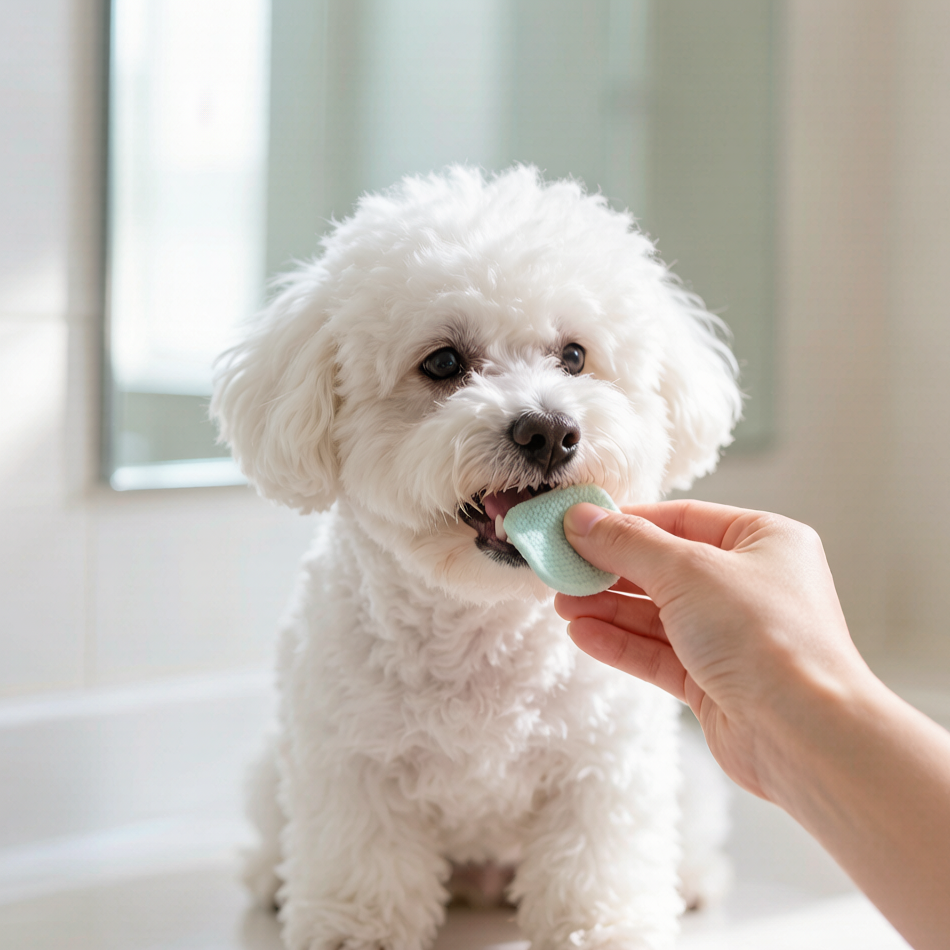
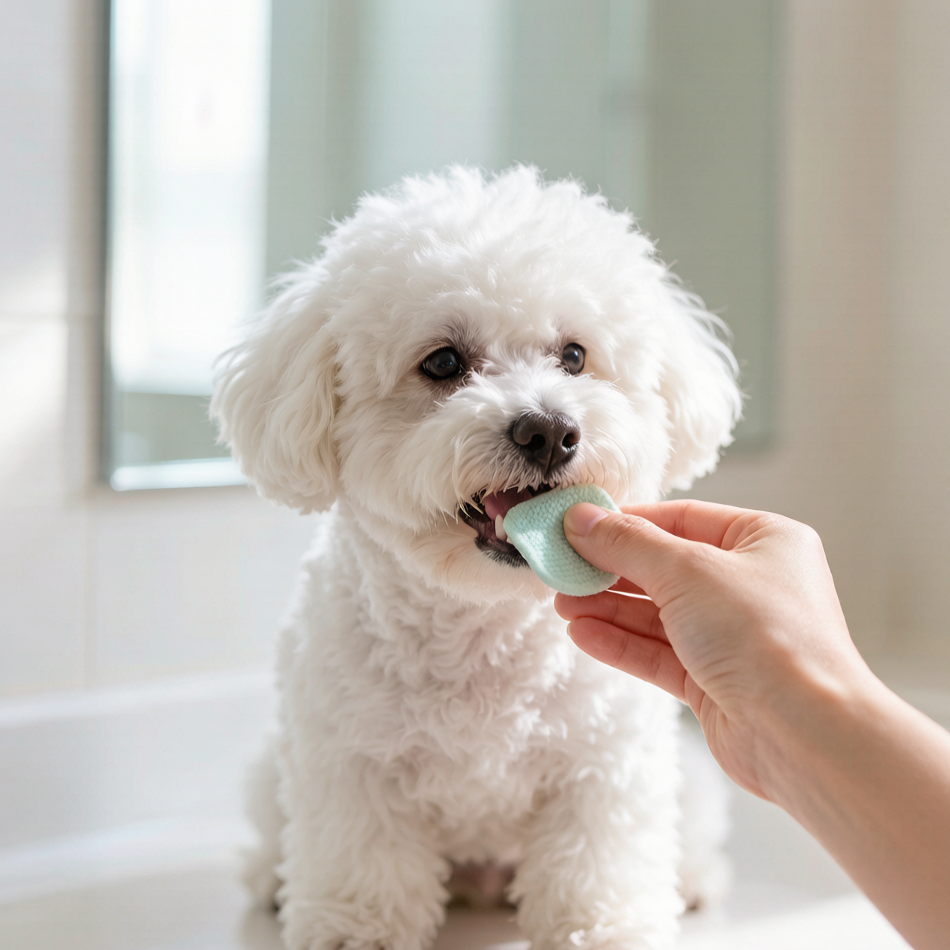
- Wipe or brush the gum line (60 seconds). A finger wipe counts. A brush counts more. The goal is friction at the gum line, not minty freshness. Do it at the same time every day so it becomes as automatic as locking the door.
- Add a water additive (5 seconds, once a week). Pour it into the water bowl and walk away. It won’t replace step one, but it slows the bacterial party between brushings.
- Hand over a dental chew (every other day). Chewing mechanically scrapes the broad front surfaces — the parts a brush misses because your dog won’t sit still.
- Book a vet check once a year. Professionals see what you can’t, and a cleaning under anesthesia is dramatically cheaper than an emergency extraction after a tooth rots.
That’s it. Two minutes, most of it while you’re already in the bathroom. Our Bichon tear stain guide matters here too — foul breath and tear staining often share the same root of poor oral and facial hygiene, so the two fights overlap.
Dental Care for Bichon Frise: Our Picks
These are the categories that earn a permanent spot, not a wishlist. Pick one from each and you’ve built the whole routine.
Dental wipes — for the days you can’t brush
Textured finger wipes knock plaque off the gum line without a struggle. They’re the lowest-friction entry point, which is exactly why they’re where most owners actually start. See dental wipes.
Enzymatic toothpaste + finger brush — the real brushing
Enzymatic paste does a little work even after you stop rubbing, and a finger brush is far less scary to a small dog than a long handle shoved in her face. Never use human toothpaste — xylitol and foaming agents are toxic to dogs. See enzymatic toothpaste.
Water additive — the passive layer
Flavorless drops in the drinking bowl that reduce bacteria between brushings. Ideal for the dog who treats a brush like a personal insult. See water additives.
Dental chews — the scraping backup
Vet-formulated chews sized for toy breeds scrape the visible surfaces and satisfy the urge to gnaw. Size down hard: a chew meant for a retriever is a choking hazard, not a tooth tool. See dental chews.
Long-handled dual brush — for reaching the back
Once your Bichon tolerates handling, a small dual-headed brush reaches the molars where tartar loves to hide. Pair it with the enzymatic paste above. See dog toothbrushes.
| Product | Best For | Key Feature | Check on Amazon |
|---|---|---|---|
| Dental finger wipes | No-brush days, beginners | Textured, gum-line friction | View on Amazon |
| Enzymatic toothpaste + finger brush | Real daily brushing | Enzymatic, dog-safe, no foam | View on Amazon |
| Water additive | Passive daily support | Tasteless, bowl-ready | View on Amazon |
| Toy-breed dental chews | Scraping + enrichment | Sized for small mouths | View on Amazon |
| Dual-head dog toothbrush | Reaching back molars | Small + large brush ends | View on Amazon |
Our pick: If you do one thing, start with the finger wipes — they’re the only step a squirmy Bichon will tolerate on day one, and consistency beats perfection. Add the enzymatic paste once she’s used to the handling. Skip nothing else forever, but wipes-first is the habit that survives.
What Actually Dissolves Plaque?
Let’s be honest, because the marketing around this gets slippery. Nothing you can swallow — no rinse, no additive, no “dental” treat — dissolves hardened tartar. Once plaque calcifies into tartar, only mechanical scraping (your brush, a chew, or a vet’s scaler) removes it. Water additives and antibacterial rinses are useful because they slow the bacteria that form plaque in the first place, buying you time between brushings. Chews help with the surfaces a dog will actually chew. But if someone promises a liquid that melts tartar off the gum line, that’s the part to ignore.
Myths Worth Killing
Myth: Dry kibble cleans teeth.
It mostly doesn’t for small breeds — see the shatter-not-scrape problem above. Some prescription dental diets have a texture that genuinely helps, but your average bag of kibble is not a toothbrush.
Myth: She eats fine, so her teeth are fine.
Dogs are experts at hiding pain. A Bichon will often keep eating normally with a rotten molar because starvation is a worse evolutionary bet than a toothache. “Eats fine” tells you nothing about her mouth.
Myth: Bad breath is just dog smell.
A mild doggy odor is normal. A breath that makes you lean back is halitosis from bacterial buildup or disease — not a personality trait. If the tuna-can test fails, something’s brewing.
When to Call Your Vet
Don’t wait for a crisis. Book a visit if you notice any of these:
- Breath that’s suddenly worse — beyond the usual doggy odor.
- Red, swollen, or bleeding gums — healthy gums are pink, not angry red.
- Yellow-brown tartar crusted on the teeth — that’s past the brushable stage.
- Drooling, pawing at the mouth, or dropping food — signs of pain.
- Reduced appetite or a sudden preference for soft food — a red flag, not a phase.
A professional cleaning under anesthesia is routine and far cheaper than an extraction. Starting dental care young makes this less likely — our puppy guide covers the early habits that pay off later.
Our Mochi Case Study
Mochi’s first dental cleaning happened at age four, after the tuna-breath incident. The vet showed me tartar I’d never seen because it sat behind her canines, and the estimate made me queasy. She came home groggy, a tooth lighter, and I felt like a negligent parent who’d been warned a hundred times. The fix wasn’t guilt — it was the two-minute routine above, starting with finger wipes because she’d never tolerate a brush cold. Six months later her gums were pink again and the goodnight kiss was safe. I’m not perfect at it; some nights it’s wipes-only. But “imperfect daily” beats “perfect monthly” every time.
Frequently Asked Questions
Are Bichon Frises prone to dental problems?
Yes. Toy breeds pack 42 teeth into a small jaw, so crowding and tartar build fast. Most dogs show some periodontal disease by age three, and Bichons are among the most affected. Daily care isn’t optional for this breed — it’s the baseline.
What dissolves plaque on a dog’s teeth?
Only mechanical removal — brushing, textured wipes, dental chews, or a vet’s scaler. Once plaque hardens into tartar, no rinse or additive dissolves it; those only slow the bacteria that form new plaque. Consistency with a brush or wipe is what actually works.
How often should I brush my Bichon’s teeth?
Ideally daily, but every other day still beats weekly. The goal is to disturb the bacterial film before it calcifies, and that window is a couple of days, not a couple of weeks. If daily brushing is unrealistic, finger wipes on the gum line are a solid fallback.
Is dental work on dogs worth the cost?
Almost always, yes. Untreated periodontal disease causes pain, tooth loss, and can let bacteria reach the heart and kidneys. A routine cleaning is far cheaper than extracting rotten teeth or treating organ damage later. Prevention costs less than the alternative.
When should I start dental care with a Bichon puppy?
As soon as those baby teeth are in — get her used to having your fingers in her mouth with a little praise and a wipe, so the adult teeth arrive to a dog who already tolerates it. Starting young is the single biggest predictor of an easy routine later.
Wrapping Up
Good dental care for Bichon Frise isn’t a product you buy once — it’s a two-minute habit you keep. Start with finger wipes, add a brush when she’ll allow it, toss in a water additive and a sized-down chew, and let the vet handle the rest yearly. Your wallet and her goodnight kiss will both thank you. For the related fight against tear stains and facial hygiene, our tear stain guide picks up where this leaves off.
Related Reading
- Bichon Tear Stain Guide — the other facial-hygiene battle, and why it overlaps with oral health.
- Best Food for Bichon Frise — what you feed shapes coat, weight, and overall health.
- Welcome to Puppyhood — build the dental habit early, when it’s easiest.
Written by Penny Hartley, certified dog trainer (CCDT) and Bichon Frise owner of 9 years. Penny learned most of this the expensive way and now keeps finger wipes on the bathroom counter.
This article was reviewed for accuracy by Dr. Laura Mendez, DVM. It is for educational purposes only and is not a substitute for professional veterinary advice. Always consult your veterinarian about your dog’s health.
As an Amazon Associate, Love Bichon earns from qualifying purchases.