Best Toothbrush for a Bichon Frise: Why Size Beats Every Feature
I once watched a well-meaning friend try to brush a Bichon with the toothbrush she uses on her Labrador. It went about as well as you’d expect: the brush head was roughly the width of the dog’s entire muzzle, Mochi treated it like a flyswatter, and we lost ten minutes and one sock to the negotiation. That afternoon taught me the thing nobody puts on the packaging — a toothbrush for a Bichon Frise lives or dies on whether it physically fits, and almost nothing sold as a “dog toothbrush” does. This guide is the short version of what I learned after that, plus the five tools that survived in our bathroom.
What’s in here:
- The reach problem: why the brush is the hard part
- What a Bichon’s mouth does to a toothbrush
- How to choose a toothbrush for a Bichon Frise
- Our picks: five tools that fit the job
- The half of the job a brush can’t finish
- If your Bichon fights the brush
- Four mistakes I made so you don’t have to
- When it’s past a toothbrush
- FAQ
The Reach Problem: Why the Brush Is the Hard Part
Every dental-care article tells you the same true thing: brush daily, or at least often. What almost none of them explain is why it fails at your house by week two. It isn’t laziness. It’s reach.
Plaque starts where the tooth meets the gum — a hairline seam, a millimeter or two wide. To disturb it, bristles have to land on that seam at an angle and move across it. On a big dog with a long muzzle, a standard dog toothbrush does this with room to spare. On a Bichon, the same brush hits the front of the canines and stops. The head is too tall to sit flat against a small tooth, too wide to turn the corner toward the molars, and the handle is longer than the dog’s face, so your wrist is steering from an awkward distance and you can’t feel what the bristles are doing.
So the dog gets the front four teeth brushed nicely, the back of the mouth gets nothing, and the tartar that will eventually matter keeps building exactly where your brush never landed. That is the whole reason a size-appropriate brush is worth thinking about for ten minutes before you buy anything.
If you want the full picture of what daily care should look like once you have the right tools, we keep the complete routine in our Bichon Frise dental care guide — this article is deliberately the narrow, tool-shaped slice of it.
What a Bichon’s Mouth Does to a Toothbrush
Three physical facts about the breed shape every buying decision here.
The teeth are big; the jaw is not
A Bichon carries the same 42 teeth as a retriever in a jaw roughly a third the size. The teeth are not scaled down to match — they’re crowded, sometimes overlapping, and the gaps between them are narrow enough that a brush head with wide bristle spacing skips right over the trouble. You want bristles packed densely enough that several tufts work at once, not a sparse row that finds one tooth and slides off.
The muzzle is short, which shortens your angle
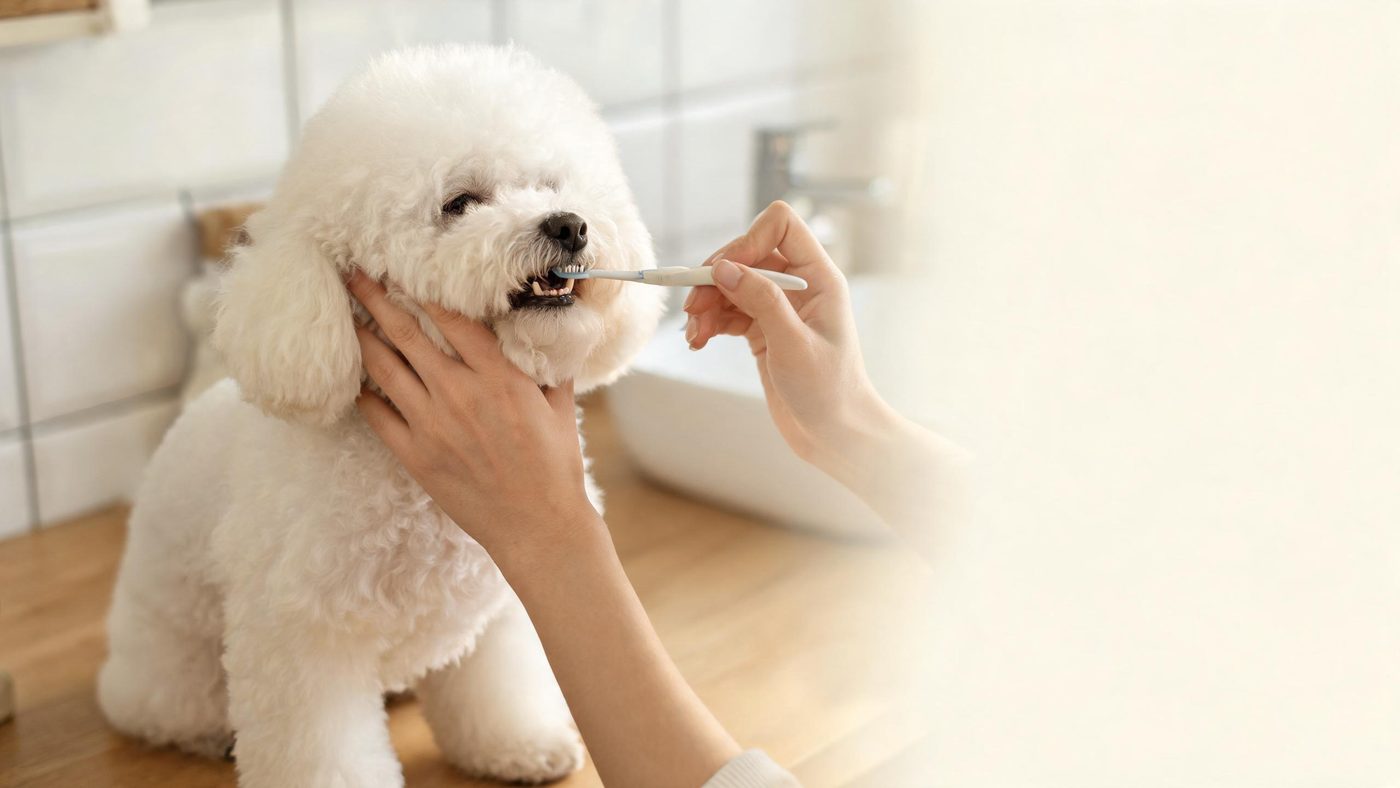
Because there’s very little distance between the nose and the front teeth, a long-handled brush forces your hand up and away from the dog’s face. A short, thin handle lets your fingers rest near the muzzle, where you can actually feel the bristles seat against the gum line and control the pressure. Counterintuitive but true: with a small dog, less handle is usually more control.
The lips and cheeks get in the way
You’ll spend as much time gently peeling a lip back as brushing. That’s normal. It’s also why a bulky double-sided head — two brush faces on one stalk — often works better than a single small head here: you can flip the angle without rotating your whole wrist inside a mouth that has no room for rotation.
None of this is exotic equipment. It’s just the difference between a tool designed for “a dog” and one designed for a mouth the size of a golf ball.
How to Choose a Toothbrush for a Bichon Frise
Ignore the marketing words. These four filters separate a brush that will still be in your cabinet in six months from one that ends up in a drawer.
- Head height, not just head width. Look for a head described for toy or small breeds, with a low profile. If the head is taller than the tooth it’s cleaning, it cannot lie flat against the gum line — and the gum line is the entire point.
- Bristle softness and density. Soft, densely packed bristles flex into the gum seam without bruising tissue. Stiff bristles on a small dog mostly irritate the gums, which teaches the dog that brushing hurts and makes the next attempt harder.
- Handle length you can feel through. Short and slender beats long and chunky. If your grip has to travel a long way to the head, you lose the tactile feedback that tells you the bristles are actually on the tooth.
- How the dog reacts to it in your hand. This is data, not sentiment. A silicone finger brush will get a nervous dog started when nothing else will, and a dual-ended brush is the upgrade once she tolerates handling. Buy for the dog you have this week, not the one you hope to have in a month.
Notice what isn’t on the list: a flavor, a color, a brand, or a promise printed in capital letters. Toothbrushes do one mechanical job, and the mechanical job is size and bristles.
Our Picks: Five Tools That Fit the Job
These are five categories rather than five brands, because the specifics change with what’s in stock — and because the fit matters far more than the label. Every link below goes to a search you can pick from.
1. A dual-headed toothbrush set — the workhorse
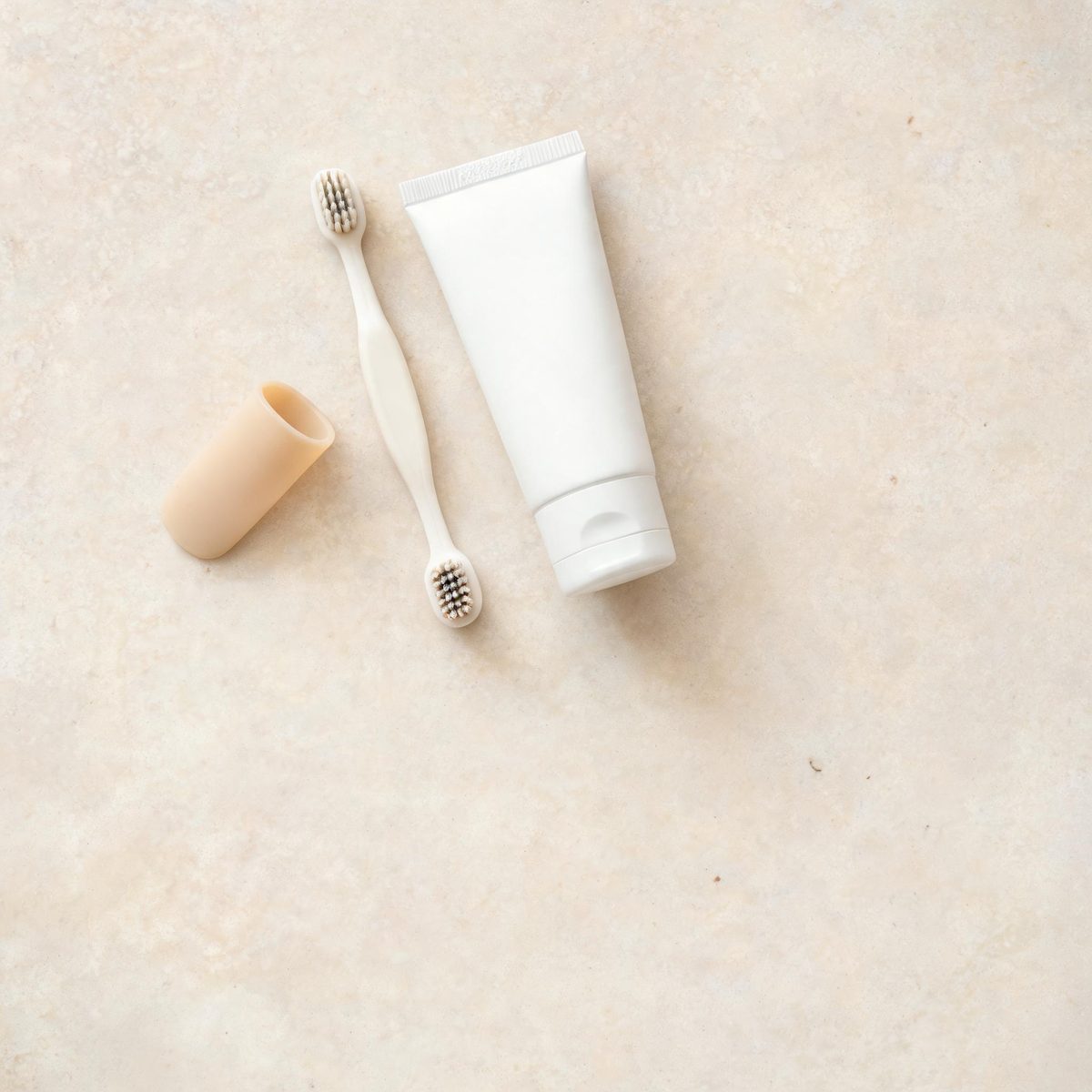
A thin stalk with a small head on one end and a larger one on the other. The small end handles the front teeth and canines; the larger end gives you more bristle for the flat outer surfaces of the molars once your Bichon trusts you near the back of her mouth. Buy it as a set rather than a single brush: heads get chewed, bristles splay, and a brush that has to be rinsed and dried between every session is a brush you stop reaching for. This one comes as eight dual-headed brushes with a couple of finger brushes thrown in for the training phase, which is more than a year of replacements for one small dog. It is the single item I’d replace first if our drawer emptied out. See small-breed dog toothbrushes on Amazon.
2. A water additive — the fifteen seconds you’ll actually keep up
I’ll be straight with you about a swap: every guide tells you to buy enzymatic toothpaste, and I was going to. But the tool that survived in our house is the unglamorous one — a flavorless dental solution you pour into the water bowl and walk away from. It doesn’t remove anything already hardened, so it is not a substitute for the brush. What it does is slow the bacteria that form plaque in the first place, which means the film your brush meets tomorrow is thinner and less organized than the one it met today. For a dog who treats a brush like a personal insult, that’s not nothing. Oxyfresh’s version is the one that stopped the breath complaints in our house, and it takes fifteen seconds a week. See pet dental water additives on Amazon.
3. The silicone finger brush — the on-ramp
A textured rubber cap that slides over your fingertip. No handle, no leverage, no clatter — which is exactly why it’s the tool that gets a suspicious Bichon used to having something in her mouth. The ones worth buying are the 360-degree style, where every surface of the cap is textured, so a wriggling dog still gets contact no matter how she turns her head. They’re sold in multi-packs for a reason: one lives on the bathroom counter, one goes in the travel bag, and one gets chewed. It cleans less effectively than bristles, so treat it as a two-to-four week training phase rather than a destination. See finger brushes for dogs on Amazon.
4. A fine-tipped tartar tool — for the visible edge, in careful hands
This is the pick on the list with an asterisk, so read this part twice. What you’re buying is a slim stainless steel scraping tool — the same family of instrument a vet or hygienist uses — for the narrow seam behind the upper canines where crowding hides the worst of it and no brush head can turn. It removes the soft, visible line of deposit at the gum edge, not the stuff packed below it. Two rules: only ever on a dog who already tolerates handling, and only with light, one-directional strokes away from the gum, because steel does not forgive impatience. If your Bichon flinches, stop and let the vet handle it. See fine-tipped dental tools on Amazon.
5. Small-breed dental chews — the backup that does the molars
Nothing you can hand a dog replaces brushing, but a chew sized for a toy breed works the broad outer surfaces of the back teeth while satisfying the urge to gnaw. Size down aggressively: a chew built for a retriever is a choking risk for a twelve-pound dog, not a tooth tool. Whimzees’ Brushzees are the ones that earn their spot here — they’re shaped with grooves that scrape as the dog works them, they’re vegetable-based rather than rawhide, and the extra-small size is genuinely sized for a Bichon. The VOHC (Veterinary Oral Health Council) acceptance on the bag is the part that matters: it means the plaque claim was tested, not merely printed. A Bichon this size gets one, not a pile — and it still doesn’t excuse you from the brush. See small-breed dental chews on Amazon.
Where the five tools land, side by side
| Tool | Best for | What to look for | Check on Amazon |
|---|---|---|---|
| Dual-ended small-breed brush | Daily brushing, front teeth and molars | Low-profile head, thin stalk, soft dense bristles | View on Amazon |
| Dental water additive | Between brushings, every bowl | Flavorless, slows plaque-forming bacteria | View on Amazon |
| Silicone finger brush | Week 1-2 desensitizing | Textured surface, snug fit on your finger | View on Amazon |
| Fine-tipped tartar tool | Visible deposit behind the canines | Slim steel tip; careful hands only, away from the gum | View on Amazon |
| Small-breed dental chews | Molar surfaces between brushings | Toy-breed size, VOHC seal, one per session | View on Amazon |
If you buy one thing: the dual-headed small-breed brush set, because it’s the only item here that does the job nothing else can. The finger brush is a bridge, not a destination — it exists to make the real brush tolerable next week. The water additive is the fifteen seconds that makes the brushing you miss matter less, and the chews are the bonus round. The tartar tool is the one to skip until the rest is a habit.
The Half of the Job a Brush Can’t Finish
Here’s the honest math: even a perfect brushing session covers the outer faces of the teeth. The inner faces, the tight gaps, and the chewing surfaces are mostly untouched — not because you’re careless, but because a Bichon’s mouth doesn’t open wide enough to give you the angle. That’s the other half of the job, and it comes from three places.
Water additives. Pour it in the bowl and walk away — that is the entire technique. It doesn’t scrape or dissolve anything, so it is not a brushing substitute, but it holds down the bacteria that build plaque in the first place between your sessions. For the dog who tolerates nothing else, this is the one intervention that survives contact with real life.
Chewing. A correctly sized chew scrapes the broad outer surfaces of the back teeth mechanically, which is what a brush does for the front teeth. It is not a substitute for brushing — dogs chew on one side, favor one tooth, and skip the gum line entirely. Think of it as the second pass, not the only pass.
Wipes and rinses. A textured finger wipe on the outside of the tooth is brushing’s understudy on the nights you’re too tired for the real thing — imperfect, but categorically better than nothing. Our full dental routine guide covers where additives, wipes and rinses each fit in the daily stack.
A yearly professional check. Not a product, and still the highest-value item on the list. Your vet sees and scales what no home tool can reach — including under the gum line, where the disease that actually costs teeth lives. Home care reduces how often you need this; it doesn’t make it optional.
If Your Bichon Fights the Brush
Resistance is almost never about the toothbrush itself. It’s about a small dog who has decided that hands near her face predict something unpleasant. Rebuild that expectation in short, boring steps, and don’t move up a rung until the current one is genuinely easy.
- Touch, don’t brush (3-4 days). Lift a lip, look at a tooth, release, treat. Ten seconds. Done. The lesson is that hands near the mouth are free money.
- Toothpaste on a finger (3-4 days). Let her lick enzymatic paste off your fingertip. Now the taste predicts something good, which is the entire reason flavored dog toothpaste exists.
- Finger brush, front teeth only (1-2 weeks). Short strokes on the outside of the canines. Stop while she’s still relaxed rather than when she’s had enough.
- Bristle brush, one side per session. Thirty seconds on the left side today, the right side tomorrow. Splitting the session is how most people actually get to daily.
- Back teeth, gently, with the small end. Only after the front is a non-event. A lip peeled back with one hand and two or three careful strokes with the other is a complete win.
If you’re at rung one and it’s going badly, back up rather than pushing through. A dog who learns that brushing is a fight will still be fighting you in a year, and the tartar doesn’t care how determined you were.
Four Mistakes I Made So You Don’t Have To
Using a toothbrush made for a bigger dog
This was the original sin. The brush was “for dogs,” the dog was a dog, so it should work — except it couldn’t fit between the cheek and the molars, and I spent two weeks thinking Mochi was difficult when the tool was simply the wrong size.
Believing a chew was the same as brushing
Chews genuinely help the chewing surfaces, and I let that fact quietly become an excuse to skip the gum line. The gum line is where periodontal disease begins, and no chew reaches it.
Starting at the back of the mouth
The back teeth are where the problems are, so that’s where I went first. That’s also the most sensitive, least familiar part of the mouth, so the very first session taught her that brushing is the worst thing that happens all day. Front teeth first, every time, for weeks.
Brushing hard to “get it clean”
Plaque is soft and comes off with light friction; pressing harder doesn’t clean deeper, it just bruises gums and guarantees the next attempt is a wrestling match. Soft bristles, light pressure, more sessions.
When It’s Past a Toothbrush
Home tools maintain healthy teeth. They don’t reverse existing disease, and one specific smell tells you that you’re past the point where a new brush will help. Book a visit if you notice any of these:
- Breath that makes you lean back — not ordinary doggy odor, but something sharp or rotten.
- Red, swollen, or bleeding gums — healthy gums on a Bichon are pale pink, not angry.
- Brown or yellow crust along the gum line — tartar, which is mineralized and cannot be brushed off.
- Dropping food, chewing on one side, or pawing at the mouth — pain signals, and dogs hide them well.
- A suddenly picky eater — sometimes a rotten tooth, not a preference.
A cleaning under anesthesia is routine, and it’s the only way to address what sits below the gum line. Nothing in your bathroom cabinet does that part.
Frequently Asked Questions
What toothbrush is best for a Bichon Frise?
A small-breed brush with a low-profile head, soft densely packed bristles, and a short thin handle — ideally dual-ended so you can switch angles without rotating your wrist inside a small mouth. Head height matters more than any other feature: if the brush head is taller than the tooth, it never lies flat against the gum line.
Can I use a regular dog toothbrush on a Bichon?
You can try, and it usually ends the same way. Brushes sized for medium and large dogs are too wide to turn toward the molars and too long to control from close to the face. The dog gets the front teeth brushed and the rest of the mouth skipped, which is roughly backwards from where tartar actually forms.
What is the best toothbrush for a small dog with a tiny mouth?
The same profile that suits a Bichon: a toy-breed head, soft dense bristles, and either a short single handle or a dual-ended stalk with a small head on one end. Silicone finger brushes are the better starting point for a nervous small dog, because there’s no handle for her to fear.
Do dental chews work as well as brushing?
No. Chews scrape the broad outer surfaces of the back teeth, which is real help, but they don’t reliably reach the gum line where periodontal disease starts, and most dogs chew unevenly. Use them as a second pass alongside brushing, not as a replacement. Look for the VOHC seal, which means the product’s claim has actually been tested.
How do I brush my Bichon’s teeth if she won’t let me?
Work in rungs: touch and treat for a few days, then a dab of dog toothpaste on a fingertip, then a finger brush on the front teeth only, then a bristle brush thirty seconds per side, and only then the back teeth. Dog toothpaste is worth having for one narrow reason — it persuades a suspicious dog that the thing in your hand is food — so buy it for the flavor, not the chemistry. Keep each session shorter than her patience and stop while she’s still relaxed. Backing up a rung beats pushing through.
Is it ever too late to start brushing a dog’s teeth?
No, but the starting point changes. If there’s visible tartar or inflamed gums, get a veterinary assessment first — brushing over diseased gums is uncomfortable and won’t remove what’s already mineralized. Once the mouth is professionally cleaned, daily brushing is what keeps it that way.
Wrapping Up
The best toothbrush for a Bichon Frise isn’t the fanciest one on the shelf — it’s the one small enough to lie flat against a small tooth, with soft bristles and a handle short enough that your fingers stay near the work. Get that one thing right and the daily habit stops being a fight; bring in a finger brush while she’s learning, pour the additive in the bowl and forget about it, and let chews handle the half of the job your brush can’t reach. For the full routine around the tool — how often, what order, and what a good session looks like — start with our Bichon Frise dental care guide, then keep the coat side of the grooming routine honest with our step-by-step guide to brushing a Bichon Frise. Two brushes, two different jobs, one dog who now tolerates both.
Related Reading
- Bichon Frise Dental Care — the full two-minute daily routine this brush fits into.
- How to Brush a Bichon Frise — the coat-side brushing guide, mats and all.
- Best Food for Bichon Frise — diet, coat condition, and overall health.
Written by Penny Hartley, certified dog trainer (CCDT) and Bichon Frise owner of 9 years. Penny’s bathroom counter currently holds three toothbrushes for one twelve-pound dog, which she considers reasonable.
This article was reviewed for accuracy by Dr. Laura Mendez, DVM. It is for educational purposes only and is not a substitute for professional veterinary advice. Always consult your veterinarian about your dog’s health.
As an Amazon Associate, Love Bichon earns from qualifying purchases.