
The Bichon Frise Puppy Essentials Checklist (Before the Chaos Begins)
Picture this: it’s 2 a.m., you’re on the floor next to a wire crate, and a three-pound puff of white fur is yelling at you in a language you don’t speak yet. Welcome to night one with a Bichon Frise puppy. You’ll get through it — but only if the house is already set up. That’s what this Bichon Frise puppy essentials list is for: the stuff that actually makes week one survivable, and the stuff you can absolutely skip.
I’ve been where you are. We brought our Bichon, Mochi, home at eight weeks, and I’d bought approximately forty things I didn’t need and exactly zero of the things that mattered at 3 a.m. So this is the checklist I wish someone had handed me — breed-specific, honest, and free of the “buy all ten of these or your dog will hate you” panic.
In this guide:
- Before you bring your puppy home
- Sleep & containment: crate, divider, x-pen
- Food & water: small-breed bowls and a slow start
- Walking gear: harness before collar
- Grooming from day one (yes, day one)
- Toys & teething sanity savers
- Cleanup & safety you’ll thank yourself for
- The 3 things worth buying first
- FAQ
- Wrapping up
Before You Bring Your Puppy Home
Here’s the part nobody tells you: the single most useful thing you can do in the week before pickup isn’t shopping, it’s puppy-proofing. Get on the floor. Look up. That charger cable dangling off the desk? Delicious, according to a Bichon. Tuck away cords, move toxic plants (lilies, pothos, anything your dog might nom), and pick up small objects. Bichons are curious and, at this age, basically a furry vacuum with legs.
And the honest part — the “don’t buy this” list. You do not need:
- A giant multi-level play gym. Your puppy needs about six square feet of safe space, not an obstacle course.
- A year of training pads “just in case.” If you plan to housetrain outside, pads teach the opposite lesson. Pick a method and commit.
- Ten different shampoos. You need one gentle whitening puppy wash (more on that below). The rest sit in a cabinet.
- A fancy GPS collar for a three-pound puppy. An engraved ID tag on a flat collar does the job for now.
- Bulk food you haven’t confirmed they’ll eat. Ask the breeder what they’re feeding and buy a small bag of that first.
Which brings us to the real list.
Sleep & Containment: Crate, Divider, X-Pen
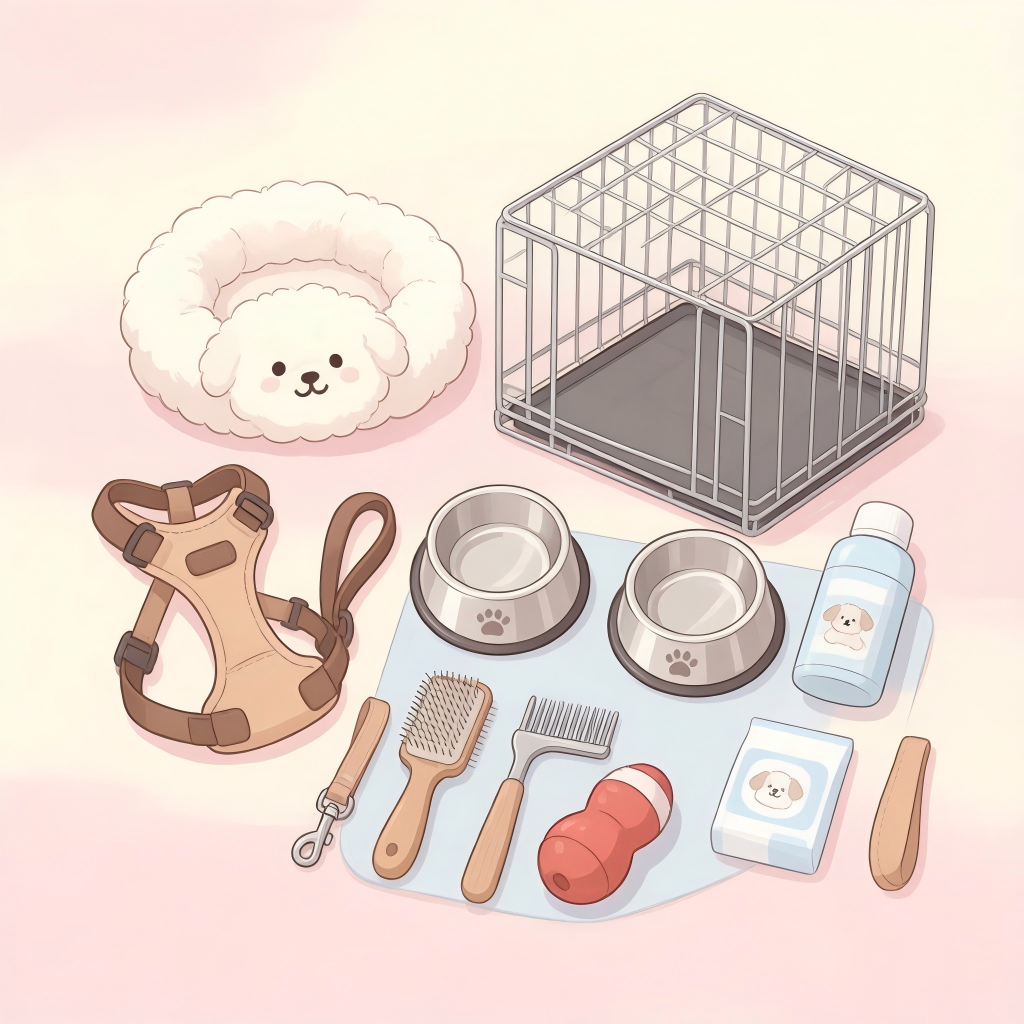
Bichon puppies are tiny — usually 3 to 5 pounds when they come home at eight weeks — and they have the bladder control of a teaspoon. A full-size adult crate invites accidents in the far corner, so get a crate with a divider and shrink it to puppy-size. It becomes their den, not a prison; dogs don’t soil where they sleep, which is the whole magic of crate training.
Pair it with an x-pen (exercise pen) so they have a safe “you can’t eat the sofa” zone while you make coffee. Add a washable crate pad or small bed — keep a spare, because accidents happen and a midnight laundry run is easier if there’s a backup.
See our pick for a small-breed crate with divider on Amazon
Bichon Frise Puppy Essentials: Food & Water (Small-Breed Bowls and a Slow Start)
Those huge stainless bowls at the pet store? They’re built for a Labrador. A Bichon puppy straining over a bowl the size of a salad plate is awkward and can encourage gulping. Get small, shallow stainless steel bowls — two, one for food, one for water. Stainless beats plastic because it doesn’t harbor bacteria or trigger chin acne.
If your puppy inhales meals, a slow feeder bowl turns scarfing into a five-minute puzzle. And the food itself: stick with the breeder’s current small-breed puppy formula for the first week, then transition slowly over 7 to 10 days if you want to switch. Sudden food changes are a one-way ticket to tummy trouble. For the full breakdown on what actually works for this breed, our best small-breed food for Bichons guide covers the picks we trust.
View small-breed puppy bowls on Amazon
Walking Gear: Harness Before Collar
Bichons have delicate tracheas — that’s the windpipe — and a yanking collar can hurt them. A well-fitting Y-front no-pull harness spreads pressure across the chest instead. Hold off on a harness for the first week or two if the fit isn’t stable yet (puppies grow fast), but make it your go-to before long walks start.
A 4-foot leash gives you more control than a 6-footer on a tiny dog, and an engraved ID tag should be on them from day one. Skip retractable leashes while training — they teach pulling and give you zero control near traffic.
See a small-breed no-pull harness on Amazon
Bichon Frise Puppy Essentials: Grooming From Day One (Yes, Day One)
This is where Bichon owners either get ahead or spend a fortune later. That baby coat feels like a cloud now, but it’s already curly and it mats — and once a mat forms against the skin, it’s painful to remove. Start the habit in week one:
- A slicker brush for the curly coat.
- A metal greyhound comb to check for hidden tangles after brushing — if the comb catches, you missed a mat.
- A detangling spray misted before every session. Non-negotiable for this coat type.
- A gentle whitening puppy shampoo. White coats show dirt (and everything else) instantly, and that first bath often can’t wait.
- Dog eye wipes for daily face cleaning. Starting this now is the single best habit for managing the Bichon tear stain guide — tear staining is a breed trademark, and daily wiping is half the battle.
Keep sessions to two minutes and full of treats. You’re not grooming a show dog at eight weeks; you’re teaching them that the brush means chicken.
View a slicker brush and comb set on Amazon
View gentle whitening puppy shampoo on Amazon
Toys & Teething Sanity Savers
Around three to four months, those needle teeth start dropping and the chewing begins. Save your shoes:
- A Kong stuffed with a tiny bit of puppy-safe food and frozen — pure gold for crate settling and teething relief.
- A small rope toy for gentle tug.
- A soft plush they can carry around (expect it to be destroyed; that’s the job).
Rotate toys so they feel new. A Bichon with an approved thing to chew is a Bichon who leaves your headphones alone.
Cleanup & Safety You’ll Thank Yourself For
Housetraining a Bichon takes longer than a big dog — small bladders, more repetition. An enzymatic cleaner is the one cleaning product you genuinely need; regular sprays leave the scent marker that pulls them back to the same spot. Buy the big bottle.
Also: book the vet visit for within the first three days, confirm pet insurance before that visit (Bichons can be prone to allergies and bladder stones, so coverage matters), and keep a “puppy drawer” with nail clippers and a damp cloth for quick face wipes.
View enzymatic cleaner on Amazon
The 3 Things Worth Buying First
If you’re on a budget and want to prioritize, here’s my honest shortlist:
- Crate with divider + x-pen — without this, housetraining and sanity both fall apart.
- Slicker brush + comb + detangling spray — start the coat habit now or pay a groomer later.
- Enzymatic cleaner — you will use it within 48 hours, guaranteed.
Everything else (harness, toys, shampoo) can follow in week two without drama.
| Buy First (week one) | Skip For Now |
|---|---|
| Crate with divider + x-pen | Giant multi-level play gym |
| Slicker brush + comb + detangling spray | Ten different shampoos |
| Enzymatic cleaner | A year of training pads (if housetraining outside) |
| Small stainless steel bowls | Fancy GPS collar for a 3-lb puppy |
| Dog eye wipes (daily) | Bulk food you haven’t confirmed they’ll eat |
Our pick: if you can only afford three things, the crate setup, the grooming trio, and the enzymatic cleaner cover the two biggest week-one pain points — housetraining and coat mats. Everything else waits politely.
Frequently Asked Questions
What do I need for a Bichon Frise puppy?
At minimum: a crate with divider and x-pen, small stainless steel food and water bowls, a slicker brush and comb with detangling spray, gentle whitening puppy shampoo, dog eye wipes, a few puppy-safe toys (a Kong is ideal), an enzymatic cleaner, and an engraved ID tag. Add a no-pull harness once the fit is stable. That’s the real Bichon Frise puppy essentials shortlist — not the forty-item store display.
How much does it cost to set up for a Bichon puppy?
The one-time setup (crate, pen, bowls, grooming tools, cleaner, a few toys) typically lands around $150 to $300 if you skip the gimmicks. Recurring costs — food, toothpaste, replacements, insurance, vet visits — run higher over the year, so budget for those too.
When should I buy a harness instead of a collar for my puppy?
Use a flat collar with an ID tag from day one, but switch to a Y-front no-pull harness for walks as soon as the fit is stable, often around 10 to 12 weeks. Bichons have fragile tracheas, and a harness protects the windpipe that a collar can strain.
Do Bichon puppies need special shampoo?
A gentle, puppy-formulated whitening shampoo is worth it — their white coats show dirt and tear staining fast. Avoid human shampoo (wrong pH) and harsh whiteners; a mild puppy wash used every couple of weeks is plenty at this age.
Can I skip the crate and just use a playpen?
You can, but most owners find both useful: the crate for sleep and the x-pen for awake supervised time. A crate teaches bladder control because dogs avoid soiling their den; a pen alone doesn’t do that as reliably.
Wrapping Up
Bringing home a Bichon puppy is equal parts joy and 2 a.m. googling. The good news: with the right Bichon Frise puppy essentials in place before pickup, week one is manageable instead of mayhem. Start with a crate and x-pen, build the grooming habit on day one, and don’t let the pet store talk you into the forty-item display. For the bigger picture on those first few months, our welcoming a Bichon puppy home guide picks up where this list leaves off.
Written by Laura Bennett, certified dog trainer and Bichon owner of 10 years.
This article was reviewed for accuracy by Dr. Emily Carter, DVM. It is for educational purposes only and is not a substitute for professional veterinary advice. Always consult your veterinarian about your dog’s health.
As an Amazon Associate, Love Bichon earns from qualifying purchases.