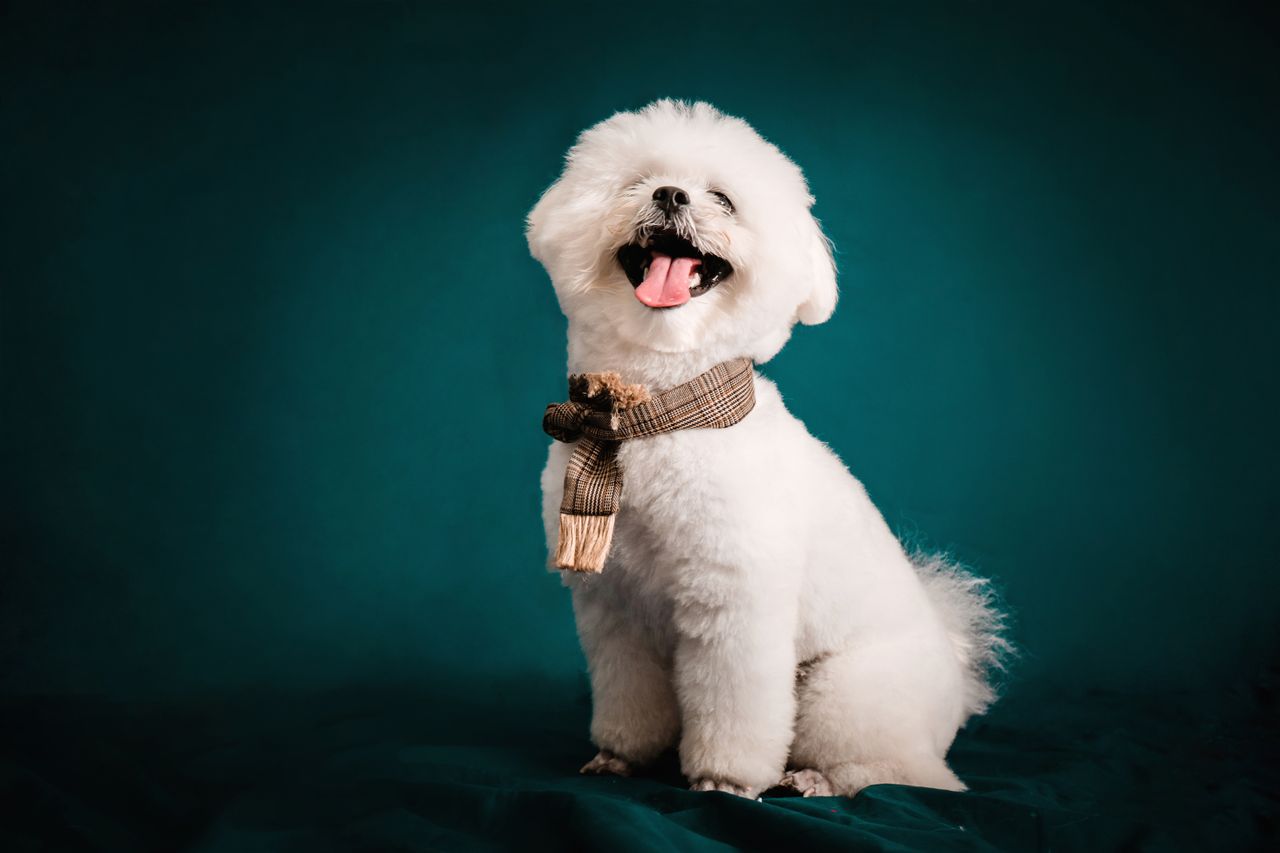
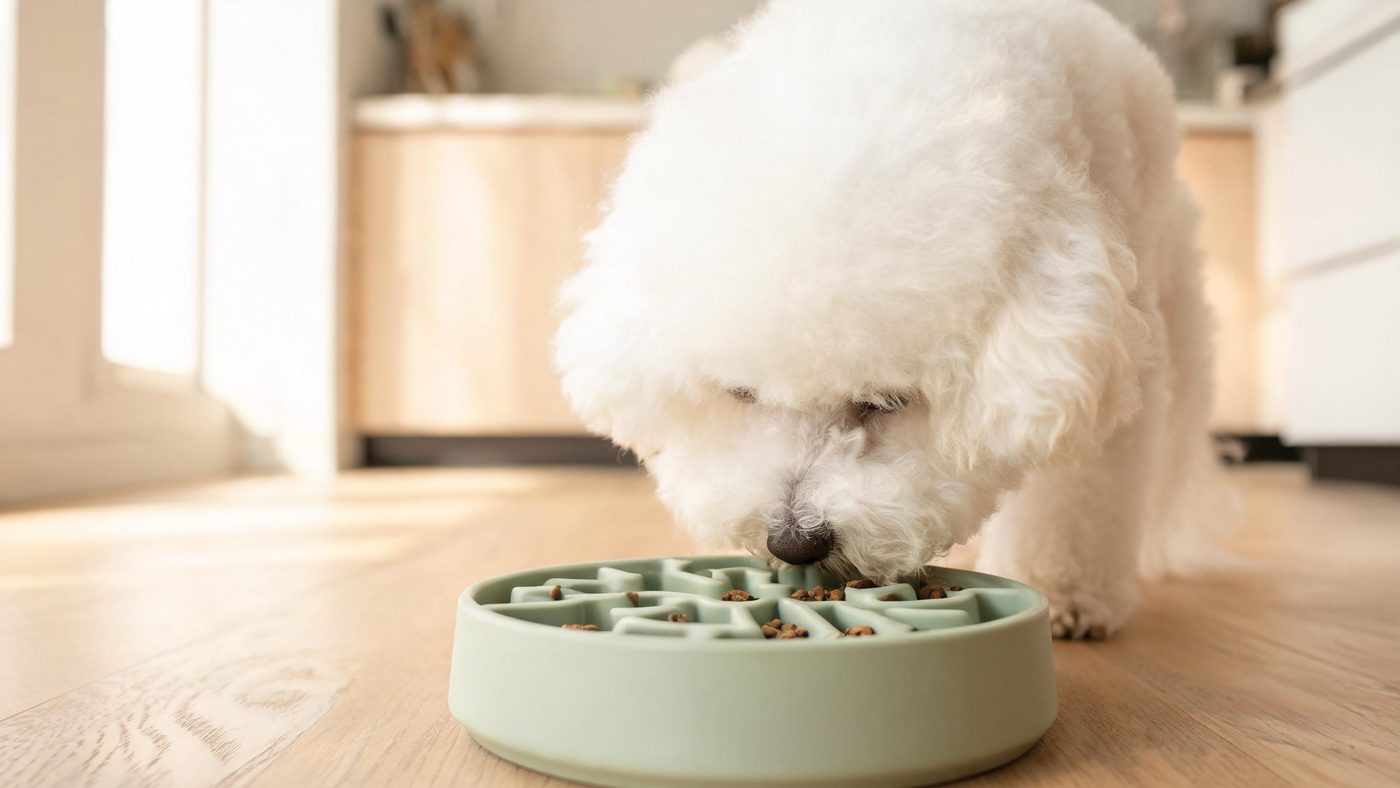
Best Slow Feeder Dog Bowl for Small Dogs: Bichon Picks That Stop the Gulping
He finished dinner before you finished setting his bowl down. Ten seconds, three-quarters of a cup of kibble, gone, followed by the sound of a small white dog licking a clean floor like he has never been fed in his life. Then, twenty minutes later, the pile on the tile: every piece undigested, in the exact shape of his stomach.
That is the moment most of us go looking for a slow feeder dog bowl for small dogs, and the pet aisle does not make the choice any easier: spiral mazes, ridged volcano cones, felt flower gardens, bowls that look like a children’s birthday party. I have gone through six of them with a Bichon who eats like he is being timed, and the honest conclusion is that the best bowl for your dog is the one matched to why he gulps and how you feed him, not the one with the most twists.
The short answer, if you want it now: the shallow maze bowl below is the one I would buy first, and the five others each solve a different version of the problem — a dog who skates the bowl across the kitchen, a dog on wet food, a dog who needs dinner to become an activity, and a speed eater whose real issue is portion size.
Why Your Bichon Inholes Dinner in Fourteen Seconds
Start with the part that surprises people: this is almost never greed, and it is almost never something you did wrong. It is wiring.
A dog’s ancestral plan for food is simple — when edible calories are in front of you, get them into the stomach before a competitor does. Chewing is a luxury that appears when there is time and when the food demands it. A Bichon was bred to sit in a lap in Nanjing, not to hunt, but the reflex came along anyway, and it comes out strongest at the exact moment the kibble hits the bowl.
Small dog, small portion, nothing to chew
Breed-size makes it worse in a way nobody talks about. An adult Bichon lives on roughly half a cup to three-quarters of a cup per meal, and small-breed kibble is 6 to 8 millimeters across — small enough that he can scoop a mouthful and swallow it whole without a single grind of the back teeth. So the meal is over before chewing could even begin. A large dog on large kibble has to work; your little velcro dog does not.
What gulping actually does to him
Air comes in with the food. A dog who inhales a meal swallows a meaningful amount of air while he does it, and air plus a sudden lump of dry kibble in a small stomach is the classic setup for regurgitation: fifteen minutes later he hunches, burps, and produces a tube of half-identifiable kibble that smells like dinner and nothing else. Owners describe it perfectly without knowing the word: he ate it, then threw it right back up, then ate that. The re-eating is not spite or starvation. It is the same reflex that caused the problem.
Worth knowing the difference, because the internet mixes them up. Regurgitation is passive, quick, and the food is undigested. Vomiting involves actual nausea — heaving, drooling, a stomach that turns over, partly digested food. A gulping problem causes the first one. The second one has a longer list of possible causes, and a bowl is not automatically the answer.
The cost that shows up on his face
Here is the Bichon-specific one. A speed eater drives his muzzle deep into a full bowl, and with a white dog that means kibble, water, and saliva packed into the fringe under his chin, several times a day, every day. Damp fur that stays damp is how rust-colored streaks and a sour smell get their start. A slower meal with less face-diving is one of the unglamorous halves of keeping tear stains and beard staining down, and it is why groomers nag about the water bowl as much as the shampoo.
The cost that shows up on his waistline
Bichons are food-motivated and they gain weight easily, and a dog who finishes in fourteen seconds spends the other twenty-three hours and fifty-nine minutes looking at you like the famine has begun. The instinct is to add a little more kibble to end the guilt trip. That is how a Bichon tips from 13 pounds into 17. Before you change a bowl, make sure the amount in it is right — my how much to feed a bichon frise walkthrough works through portions, meal counts, and treats without guessing.
One line worth remembering: a bowl changes the speed of a meal. It changes neither the calories nor the medical reasons a dog might be eating fast.
Does a Slow Feeder Actually Help? Where the Evidence Stops
Yes for the problem it is designed for, and no for the ones marketing leans on. I would rather you buy the right thing than buy mine.
What they genuinely do
They force chewing. A maze or ridge pattern makes it physically impossible to get a whole mouthful, so he has to lap, nudge, and separate pieces, and pieces that get lapped separately usually get chewed at least once. That alone fixes a lot of the “eats fast, throws up” loop.
They stretch the meal into an activity. Fourteen seconds of nothing versus six to ten minutes of nose and tongue work is a real difference in a day. Owners notice it less in the bowl and more in the fact that he naps instead of stalking the pantry.
They make a small portion feel like an event. That matters for the waistline conversation above: the same measured cup of food, worked for, reads as a bigger deal to the dog than a cup he annihilates and then complains about.
What nobody should promise you
Bloat. Gastric dilatation-volvulus is a genuine emergency and the reason speed eating gets treated as dangerous, but it is overwhelmingly a deep-chested large-breed problem; a 13-pound Bichon is not the dog the studies are about. Slowing a gulper down is sensible husbandry. Treating a maze bowl as bloat insurance is not, and the marketing on some of these products badly overstates it.
Raised bowls. A related piece of folk advice is to put the food on a stand. The opposite association shows up in the veterinary literature: in a large survey of dogs, raised feeding was associated with a higher risk of bloat in the at-risk breeds rather than a lower one. Nobody is going to argue that elevation helps a small dog eat slower, so you will not find an elevated feeder on this list. If you already love one, that is your call — just don’t buy it as a health upgrade.
Weight loss. A slow feeder does not reduce a single calorie. It is a tool for the manner of eating, and it pairs with a measured portion, not instead of one.
When it is not a bowl problem
Get a veterinary look rather than another product if you see any of these. He regurgitates even when you feed him tiny amounts by hand, or from a flat plate. He cannot keep water down. There is blood, or the vomit smells foul in a way the usual regurgitated dinner does not. He is losing weight, seems quieter than normal, or his appetite has changed suddenly. And if he is retching with a hard, distended belly and producing nothing, that is an emergency room, not a message board.
Regurgitation that keeps happening deserves a diagnosis even when it looks exactly like the gulping story. Small dogs get esophageal and motility problems too, and a vet who hears “he inhales it and brings it back up, every day, for months” is right to want to look.
How to Choose the Best Slow Feeder Dog Bowl for Small Dogs
Five filters, in the order I use them. Together they eliminate most of the aisle in about two minutes.
1. Shallow and wide beats deep and twisty. On a dog with a short body, a moderate muzzle, and 12 pounds to push with, deep spiral channels are frustrating rather than interesting. Watch a Bichon at a really aggressive maze and you see the failure mode: two confident laps, no food, head comes up, and the dog gives up or starts pawing the bowl across the room. Wide, shallow ridges let him succeed slowly, which is the entire point. If a line offers difficulty levels, start at the easiest one you can find and only escalate if he beats it.
2. Capacity matched to his actual portion. Measure his dinner once and write it down. If it is three-quarters of a cup, a 4-cup volcano means the kibble sits in one corner of an empty landscape and he gets it in three laps. The right size is the one where the food actually spreads across the pattern.
3. A material you can keep genuinely clean. Every ridge on these things is also a food trap. Maze bowls get slimy faster than flat bowls, so this is a hygiene decision as much as a feeding one. Plain plastic scratches and holds onto oil; glazed ceramic and stainless steel do not. Whatever you choose, it should either go in a dishwasher or be a shape you can scrub in ten seconds — because if cleaning is a chore, it gets skipped, and a crusty slow feeder is worse than a clean plain bowl.
4. It has to stay put. Hardwood and tile plus a determined little nose equals a bowl that skateboards three feet before the first bite. Three ways to solve it: weight (ceramic and steel), a non-slip ring on the base, or suction cups on a smooth, clean, hard surface. Note the condition on that last one — suction cups do nothing on rug, textured tile, or a floor you have not wiped, and they fail quietly the first time.
5. Match it to the food you actually serve. Dry kibble is the easy case. If your Bichon gets wet food, a topper, a raw mix-in, or liquid medication worked into his meal, a maze becomes a grouting job, and a flat grooved mat you can wipe or rinse is the better tool. And if you are picturing freezing a spread of food into a pattern, check that the item is actually labeled freezer-safe rather than assuming silicone automatically is.
The 6 Picks, Each for a Different Job
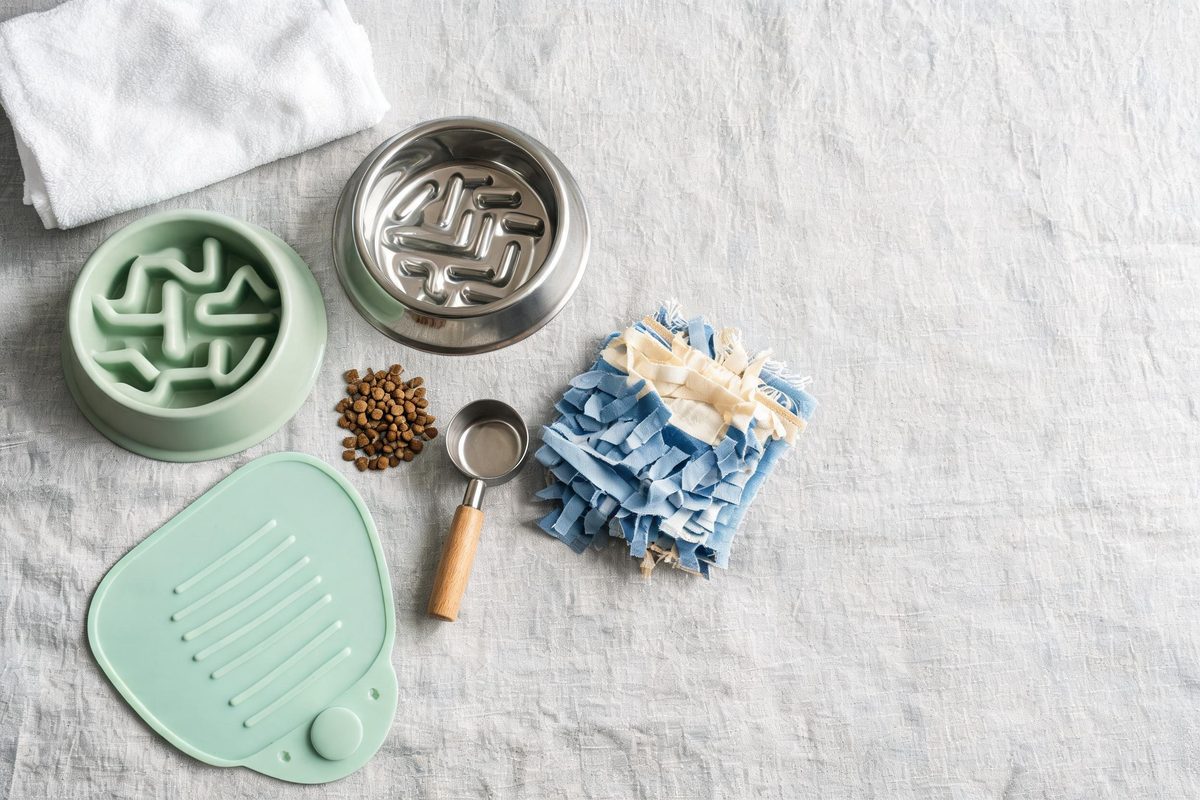
1. The one to start with: a shallow plastic maze bowl sized for a small dog
If you feed kibble and want one purchase that answers the question, this is the category. The version I would pick is the small wave-pattern bowl from the most established slow-feeder line on Amazon: it holds three-quarters of a cup of dry or wet food, the pattern is wide and shallow rather than a corkscrew, the base is non-slip, and it is top-rack dishwasher safe. The material is polypropylene with no BPAs, PVCs, lead, or phthalates, and the line is sold in multiple sizes and patterns with three difficulty levels, which is exactly the flexibility a fussy eater needs.
It is also the most thoroughly field-tested product in this whole category by an absurd margin: around 4.6 stars across 135,000 ratings, and it is the item people mean when they say “just get one of those maze bowls.” The brand’s own copy claims it slows eating dramatically; treat that number as marketing and your own stopwatch as the truth.
The honest trade-offs: it is plastic, so as the years and dishwasher cycles go by, watch for scoring and scuffing in the channels. Three-quarters of a cup is a real limit — if your Bichon is on a bigger ration, you want the next size up rather than two helpings in this one. And a shallow maze is, by design, the easiest level; a clever food-obsessed dog can beat it.
2. For the dog who pushes the bowl across the kitchen: a heavy ceramic slow feeder
Ceramic solves two complaints at once: mass and surface. This one is a small-breed bowl holding about 0.6 cups, weighs roughly 0.45 kg (just under a pound) with a non-slip base, and has a smooth glazed surface over a ridged maze. Nothing about a half-kilo glazed bowl moves when a 12-pound Bichon leans into it, and glaze does not absorb fat the way scratched plastic does. It rinses clean and goes in the dishwasher.
The capacity is deliberate: 0.6 cups is a Bichon meal, so the kibble sits spread across the pattern instead of pooling in one corner of a bowl built for a spaniel. It holds around 4.7 stars across a little over 3,000 ratings, and it comes in several colors and larger sizes if you have a bigger dog too.
The honest trade-offs: it will break if it ends up on the floor, and a bowl dropped from a counter is a one-time purchase. The ridges are tighter than the wave bowl, so a dog who is easily frustrated does better with pick one. And the small version holds less than a full cup, which matters on the days you mix in wet food.
Look at the small-breed ceramic slow feeder.
3. The one you can keep truly clean: a stainless steel maze bowl
If hygiene is what actually bugs you about maze bowls, steel is the answer, and this is the version I would choose for a small dog. It is food-grade 304 (18/8) stainless with a double-layer welded wall, holds 1 to 1.5 cups, carries a raised maze pattern, and the smooth metal surface takes dry kibble, wet food, and anything else you serve. A silicone ring on the base plus about 0.77 lb (350 g) of weight keeps it from wandering, and it is dishwasher safe. The listing describes the steel itself as bite-resistant, which plastic is not.
It carries around 4.6 stars across 1,400 ratings and is the smallest size in a full line, so if it works you can scale up for a second dog.
The honest trade-offs: the rating base is far smaller than the two bowls above, so it is a newer product with less long-term field data. Steel is loud, and a dog with a metal-tag collar will let you know. And steel with a thin base can still slide on a rug — the silicone ring needs hard floor to do its job.
See the small-breed stainless maze bowl.
4. For wet food, toppers, and meds: a suction silicone grooved bowl
A maze is a bad fit for anything spreadable — you are essentially grouting. What works for wet food, a spoon of bone broth, pumpkin, a soaked kibble mash, or the daily pill hidden in food is a flat, shallow, grooved surface that sticks to the floor.
This one is food-grade silicone, BPA-free, about 7.5 inches across and 1.5 inches deep, with a labyrinth of shallow grooves and suction cups underneath. The listing puts it on 5 to 30 pound pets, which is squarely Bichon territory, and it is dishwasher safe. Around 4.5 stars across 1,000 ratings, and it is the pick for the dog who eats like a woodchipper, because a stuck-down bowl cannot be flipped or launched.
The honest trade-offs: suction needs a smooth, clean, hard floor and it will release if a determined dog works one corner loose, so this is a tile-and-hardware solution, not a rug solution. It is a light object, so on its own it does no resisting until it is stuck. And it is a house-brand listing rather than an established one, so read the current dimensions before ordering if you have a specific spot in mind.
Check the suction silicone grooved bowl.
5. To turn dinner into twenty minutes of nose work: a snuffle mat
This is the pick for a different problem: not “he gulps” but “dinner is over and he is now a bored prison inmate.” A snuffle mat spreads the same measured cup of kibble into a field of fabric strips he has to sniff and fish out, which converts a fourteen-second inhale into the closest thing an apartment dog gets to foraging. It also burns mental energy in a way a bowl never will, which is why they show up in almost every enrichment conversation.
My pick here is one of the longest-selling mats on Amazon — around 22,000 ratings — with a non-slip cloth base, fabric strips that fold into a bowl shape for storage, and a pack-down size small enough for a crate or a suitcase. The category rating is honestly mediocre (about 4.2 here), and I would not pretend otherwise: some dogs eat the felt. If yours is a fabric chewer, this is not your product.
The Bichon-specific warning: his whole face goes into this. On a white dog that is saliva and crumb deposit in a textile you then have to clean, and the maker suggests hand washing rather than a machine. If you want it in the laundry, filter for machine-washable mats specifically — several newer ones are, and it is the single most useful spec on the label for a bearded white breed.
6. The unglamorous purchase that fixes more than a bowl: a measuring scoop
Somebody has to say it: a lot of “he needs a slow feeder” cases are really “nobody has measured his food since the breeder’s sheet.” A plain 1-cup stainless scoop with printed markings costs less than either of the bowls above and addresses the cause instead of the symptom. This one is 304 stainless with a walnut handle and clear gradations molded into the cup, it is dishwasher safe, and it is an Amazon’s Choice at around 4.8 stars across 1,400 ratings in a category where almost nothing else has a number printed on it.
Use it with a bowl you trust. The two together are the actual answer to the fast-eating Bichon: the right amount, eaten slowly. If his weight or appetite is the real conversation, start with the best food for a bichon frise and work out what a correct ration looks like before you buy equipment.
Look at the marked stainless scoop.
Side-by-Side Comparison
| Pick | The job it does | Capacity | Material | Stays put by | Cleaning |
|---|---|---|---|---|---|
| Small wave maze bowl | Start here for a kibble-fed gulper | 3/4 cup, dry or wet | Polypropylene, no BPAs or PVCs | Non-slip base | Top-rack dishwasher |
| Small-breed ceramic bowl | The dog who skates the bowl | 0.6 cup | Glazed ceramic | Weight, about 0.45 kg, plus non-slip base | Rinse or dishwasher |
| Stainless maze bowl | Hygiene, wet food, rim chewers | 1 to 1.5 cups | 304 (18/8) stainless, double wall | Silicone ring plus 0.77 lb | Dishwasher |
| Suction silicone bowl | Spreadable food, toppers, pills | 7.5 in across, 1.5 in deep | Food-grade silicone, BPA-free | Suction cups on hard floor | Rinse or dishwasher |
| Snuffle mat | Dinner as nose work, boredom | Whole ration hidden in strips | Fabric strips, non-slip cloth base | Cloth base | Hand wash suggested |
| Marked steel scoop | The portion under all of it | 1 cup, printed markings | 304 stainless, walnut handle | Not applicable | Dishwasher |
What I Would Buy for My Own Bichon
Two items, and only if he is a healthy fast eater: the shallow wave maze bowl for kibble, and the marked scoop so the portion in it is the portion he should be eating. That pair costs less than one bag of the fancy food he inhales, and it addresses both halves of the problem.
Add the ceramic bowl if he is the kid who pushes, or the stainless one if you would rather scrub metal than plastic. If most of his meals include something wet or spreadable, skip the maze and live on the suction mat. And the snuffle mat is not really feeding equipment at all — it is twenty quiet minutes on a rainy day, which is why almost every Bichon owner ends up owning one anyway.
Six Things That Slow Down a Speed Eater for Free
Try these before ordering anything. Two of them work as well as a purchased bowl, and they cost you a dinner’s worth of patience.
1. Test with a muffin tin. Put his measured kibble into the cups of a muffin pan and watch. If he slows down and finishes it, you know a maze works and roughly how much difficulty he needs. If he flips it or gives up, you have just saved yourself a return and learned that he needs the shallowest thing available.
2. Scatter-feed on a clean floor. Throwing dinner across the kitchen tile turns the same calories into a sniffing session, and it is the oldest trick in the behaviorist’s kit. Not for multi-dog houses, and not on a floor you just mopped, but as a diagnostic it is unbeatable.
3. Smaller and more frequent. Three small meals are harder to inhale dangerously than one big one, and easier on a dog who regurgitates. This is a schedule change, not a purchase, and it is the one most vets suggest first.
4. Feed him away from the other animals. A dog who thinks his food is contested eats fast for reasons no bowl can fix. A crate, a closed door, or a baby gate between dinner spots solves more than any spiral. If the crate is the answer, my best crate for a bichon frise guide covers the sizes that let a dog sit and turn comfortably.
5. Take the bowl away between meals. Free-feeding a grazing dog and then wondering why the one meal you sit down to looks urgent is a mixed message. Fifteen minutes on the clock, then up.
6. Give the brain a job before the stomach does. A short training session or a stuffed chew before dinner settles a lot of the theatrics, and it doubles as the enrichment most indoor Bichons are short on — see bichon frise toys for the ones that hold up, and calming routines for a reactive little dog if dinner-time arousal is the wider issue.
One more, since it costs nothing and gets asked constantly: brushing his teeth matters more than most people think, and a dog who never chews anything is also a dog whose teeth are getting no mechanical cleaning at all. That is the link between the gulping habit and the brown tartar by the gumline, worked out properly in bichon frise dental care. If he is a puppy, sort the bowl question out early — bichon frise puppy essentials lists the gear worth buying once.
FAQ
Do small dogs need a slow feeder dog bowl?
Not automatically. A small dog who sits down, eats for a minute, and walks away needs nothing. A dog who inhales, regurgitates undigested food afterward, raids the counter, or competes with another pet usually benefits, and the pattern of the problem tells you which style of bowl to reach for. Size alone is not the reason; speed is.
Why does my dog eat so fast and then throw up?
Most often because he swallowed air and a lump of dry food faster than his stomach liked, and it came back up undigested a few minutes later. That is regurgitation rather than true vomiting. A maze bowl, a smaller portion, or two smaller meals usually fixes it. If it keeps happening even with tiny hand-fed amounts, or he cannot keep water down, that stops being a bowl question and becomes a vet question.
Are slow feeder bowls good for dogs?
They are a reasonable tool with a narrow job: they lengthen the meal and force the dog to work for individual pieces. The real-world benefits are fewer gulped-and-returned meals and a bit of mental stimulation. They are not medicine, they do not lower calories, and the difficulty needs to suit the dog — a puzzle your Bichon gives up on is a worse outcome than a plain bowl he eats from calmly.
Can you use a slow feeder bowl for wet food?
You can, but a maze is the wrong tool. Wet food, broth, pumpkin, and soaked kibble smear into the channels, and you are left scrubbing, which leads to the bowl being cleaned less often. For anything spreadable use a shallow grooved mat or a flat bowl, or freeze the portion into a pattern only if the item is labeled freezer-safe. Some maze bowls do officially list wet food as a use; the trade-off is cleaning, not safety.
What size slow feeder dog bowl should I get?
Measure one meal, then buy a bowl where that amount spreads across the pattern rather than sitting in one corner. For most adult Bichons that is between half a cup and three-quarters of a cup, so a small bowl with a shallow pattern works and a huge one defeats the point. If you also serve wet food or mix-ins, add room for that volume.
My dog gave up on his slow feeder bowl. What now?
The pattern is too hard for him, or he is too hungry for it. Drop to the easiest difficulty level, put a fifth of his portion in a plain bowl alongside the puzzle so he never panics, and increase the puzzle share over a week. Keep the total the same. A frustrated dog who refuses the puzzle is telling you something useful about muzzle length and patience.
Wrapping Up
A slow feeder dog bowl for small dogs is worth owning for exactly one kind of dog: the healthy one who inhales. Match the difficulty to the dog, the capacity to the portion, and the material to how you clean, and you get a meal that lasts minutes instead of seconds and a lot less kibble coming back up. Start with the shallow maze bowl, keep the scoop in the food bin, and let the muffin tin tell you whether your Bichon is a puzzle dog at all.
Skip the raised feeders, skip any product that promises to protect him from bloat, and call your vet about regurgitation that keeps happening no matter what you feed him from.
Written by Penny Hartley, certified dog trainer (CCDT) and Bichon Frise owner of 9 years. She has fed a competition-level speed eater through six bowls, two mats, and one very patient veterinary visit, and tests every product in this guide before recommending it. Last updated: October 2026.
Vet note: This guide is general care information and has been reviewed for accuracy by Dr. Lena Marsh, DVM, a small-animal veterinarian. It is not a substitute for veterinary advice. Repeated regurgitation, vomit containing blood, an inability to keep water down, weight loss, a sudden change in appetite, or retching with a hard distended abdomen should be assessed by your veterinarian rather than managed with a feeding product.
Amazon disclosure: As an Amazon Associate, Love Bichon earns from qualifying purchases. This page contains affiliate links, so if you buy through them I may earn a commission at no extra cost to you. I only recommend products I have used on my own dog, and the commission never changes which bowl I would put on the floor.