Bichon Frise Potty Training: Why It Takes Longer Than the Books Promise
Nobody warns you about the bladder. You bring home four pounds of white fluff with a bow on his collar, and inside a week you own three kinds of stain remover and a dog who has decided the hallway rug is a bathroom. Bichon Frise potty training is not harder because your dog is stubborn or slow. It is harder for four specific reasons, and three of them are things you can change before the weekend.
We got this wrong for a solid month with our own Bichon, Biscuit. We took him out every three hours, felt extremely organized about it, and then watched him pee twice in the ninety seconds between the back door and the living room. We were tracking the clock. We were not tracking him.
If you want the short version: the fix was a schedule that did not depend on him telling us anything, plus a cleaner that actually removes the smell instead of covering it. Start with a two-pack of machine-washable pee pads with a grippy backing so a miss is a load of laundry instead of a carpet emergency, and read the rest below for the why.
In this guide:
Why Bichon Frise Potty Training Takes Longer Than the Books Promise
Search “how long to housebreak a puppy” and you will get a confident answer: a few weeks, maybe a couple of months. Then you get a Bichon and discover that the timeline in the books was written for a Labrador. The breed is not difficult on purpose. It is just a small companion dog with a particular set of instincts, and that combination runs straight into the way most of us train.
The bladder math is unforgiving
A twelve-pound Bichon has a bladder to match, and a puppy’s is smaller still. The widely used rule of thumb is one hour of holding per month of age, plus one — which sounds generous until you do the arithmetic for an eight-week-old. That is roughly one hour of control, and it counts from the last time he emptied, not from the last time you thought about it.
Here is what that looks like in practice, and why “every three hours” fails so early:
| Age | Realistic bladder control | Trips outside per day |
|---|---|---|
| 8–10 weeks | About 1 hour | 12–14 |
| 3 months | 3–4 hours | 8–10 |
| 4 months | 4–5 hours | 6–8 |
| 6 months | Up to 6 hours | 5–6 |
| 12 months and up | 6–8 hours | 4–5 |
Two things about that table are worth saying out loud. First, it is a rule of thumb, not a law — some puppies run ahead of it and some run behind, and behind is not a training failure. Second, nighttime is genuinely different. A sleeping puppy is not producing urine at the same rate as a wrestling one, which is why most puppies can sleep through the night well before they can hold it through an afternoon.
He was bred to be with you, not out in the yard alone
This is the part that catches people out. Bichons were developed as companion dogs — lap dogs, essentially, bred for centuries to be wherever their person is. Sending him outside alone and shutting the door is not a neutral act to him. It is a demotion.
So he does the logical thing: he stands at the door, waits for you to come back, and then pees on the mat the moment he is inside again, because inside is where you are. Owners read this as defiance. It is the opposite. It is a dog who would rather hold it and be with you than go and be alone.
The fix is unglamorous and it works: go out with him. Every single time, for the first few weeks. Stand there. Be boring. Reward him out there, not at the door.
A strong opinion about the weather
Bichons are small, close to the ground, and wrapped in a curly white coat that soaks through and mats when it gets wet. A five-minute trip into a cold rain is not a neutral event for this breed. It is cold on the way out, and it means a wet, matted coat to brush out on the way back in.
Which is exactly why the training quietly falls apart in bad weather. If your Bichon works out that holding it earns him a fast ticket back to the warm hallway, he will hold it — and then use the hallway. This is the most common reason a dog who was “almost trained” in August is suddenly unreliable in November. He is not forgetting. He is negotiating.
Meet him halfway: a covered spot close to the door, a light dog coat on the genuinely cold days, and the same patch of ground every single time so the smell does the work for you. If you are never quite sure how cold is too cold for him, our guide to what temperature is too cold for a Bichon Frise walks through the thresholds and the winter walk routine.
And then there is the pee pad contradiction
Pads are genuinely useful. They save your floor during the weeks when your puppy physically cannot hold it, and they are close to essential in an apartment or a high-rise where getting outside takes four minutes. But a pad teaches one lesson very clearly: indoors is a bathroom. Then month two arrives and you have to un-teach it.
This is why so many owners report that their Bichon was “doing great” and then fell apart at four or five months. Nothing fell apart. The dog learned exactly what he was taught, and now the rules have changed underneath him. Use pads as a containment tool — inside a pen or next to the crate — and move the pad toward the door and then outside as he grows, rather than leaving it in the same corner forever.
How Long Does It Take to Potty Train a Bichon Frise?
The honest answer is four to six months for reliable, unsupervised house training, with the bulk of the work happening in the first six to eight weeks. Owners who say “it took three weeks” almost always mean “he stopped having accidents while I was watching him every second,” which is a different milestone.
It helps to split it into three goals, because they arrive at very different times:
- No accidents while supervised — usually 2 to 4 weeks with a real schedule.
- Asking to go out — usually 4 to 8 weeks, once a signal is being taught deliberately.
- Trustworthy with the run of the house — 4 to 6 months, and it depends more on bladder maturity than on training.
If your Bichon is eight months old and still having the occasional accident when you are out for five hours, that is usually a bladder-and-schedule problem rather than a disobedience problem. If he is eight months old and peeing on the sofa while you watch, that is a training gap, and the four-week plan below is where to start.
The Mistakes That Keep a Bichon in Pull-Ups
Almost every Bichon potty training problem we have seen traces back to one of these six. Run down the list honestly before you change anything else — one of them is usually the whole answer.
- Free-feeding. A bowl that is always full means output at unpredictable times, which means you cannot build a schedule. Two or three measured meals, bowl down after fifteen minutes, and the day starts to have a shape.
- Cleaning with the wrong thing. Urine leaves uric acid crystals that survive ordinary soap, and a dog’s nose reads them as “bathroom, use again.” This is why he returns to the exact same spot on the rug. You need an enzymatic cleaner that breaks the crystals down, not a freshener that covers them.
- Punishing after the fact. A Bichon cannot connect a scolding to something he did twenty minutes ago. He connects it to you walking through the door, which is how you get a dog who hides to pee instead of asking to go out. Interrupt only in the act, then straight outside.
- Too much freedom too early. A twelve-week-old Bichon with the run of the house is not house-trained — he is unsupervised. Crate, pen, tether or closed door until he has earned the next room.
- Relying on him to tell you. Puppies do not reliably signal until the habit is already formed. For the first two weeks, the clock decides, not the dog.
- Going quiet on the reward. Praise at the door when he comes back in rewards the wrong end of the trip. He needs to hear it out there, within about two seconds of finishing.
The Four-Week Bichon Potty Training Plan
This is not a clever method. It is the boring one that works, and it is built around the two things that actually move a Bichon: a schedule he can predict and a reward that lands at the right moment. If you already have the right crate, this slots together with crate training for a Bichon Frise — the crate is what makes the schedule survivable when you cannot watch him.
Week 1 — Schedule and confinement
Take him out on the clock, not on his signals: first thing when he wakes, within five to twenty minutes of every meal, after every nap, after every play session, before bed, and once in the middle of the night if he is under four months. Same door, same patch of ground, every time.
Between trips he is either in the crate, in a pen, or tethered to you. Yes, that is a lot of crate time in week one. It is temporary, and it is the reason the habit forms.
Reward outside, immediately. This is where soft treats earn their place — a crunchy biscuit takes ten seconds to chew, and ten seconds is long enough for a puppy to lose the thread of what he just did. Something small and soft he can swallow in one bite keeps the connection intact.
Week 2 — Add a signal
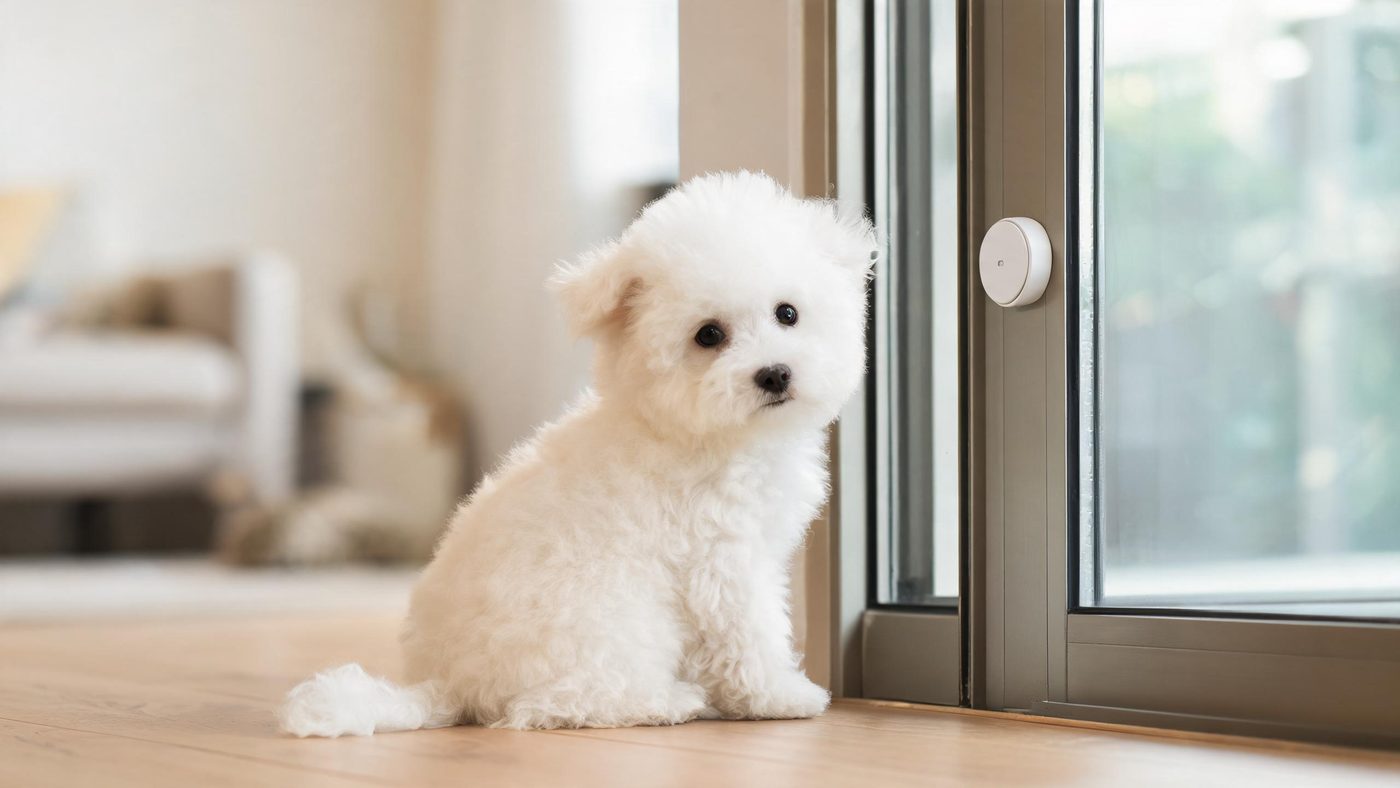
Now teach him how to tell you. A wireless door bell mounted at nose height is the easiest version of this, because it is a deliberate action rather than a bark you may or may not hear from the kitchen. Ring it yourself with his paw before every trip out for a week. Reward the ring and the result.
Expect him to ring it for fun, for attention, and for no reason at all. That is fine. Answer it every time for now; you can sort out the false alarms once the association is solid.
Week 3 — Widen the territory
Give him one room instead of the crate, with the door closed, while you keep the same schedule. Stretch the interval by fifteen minutes every few days, and keep a note of when he succeeds and when he does not — you are looking for his actual limit, not the number in a book.
This is also the week to handle the pad transition if you have been using pads indoors. Move the pad a foot closer to the door each day, then onto the doorstep, then outside onto the same patch of grass. It is slower than going cold turkey and it produces far fewer accidents in a high-rise.
Week 4 — Proof it
Two rooms, then the whole house, with the crate still available as his own space. Start thinning the reward to every other success, then every third, so the behavior does not depend on you holding a treat. Keep the schedule for a couple more weeks even though he seems fine — the schedule is what got you here.
One last thing about this plan: it assumes a healthy puppy. If he has diarrhea, a stubborn schedule will not fix it, and you should be looking at what he is eating — our Bichon puppy essentials checklist covers the first-month setup, and how much to feed a Bichon Frise will get the portions right if the timing of his meals is part of your problem.
The Gear That Actually Moves the Needle
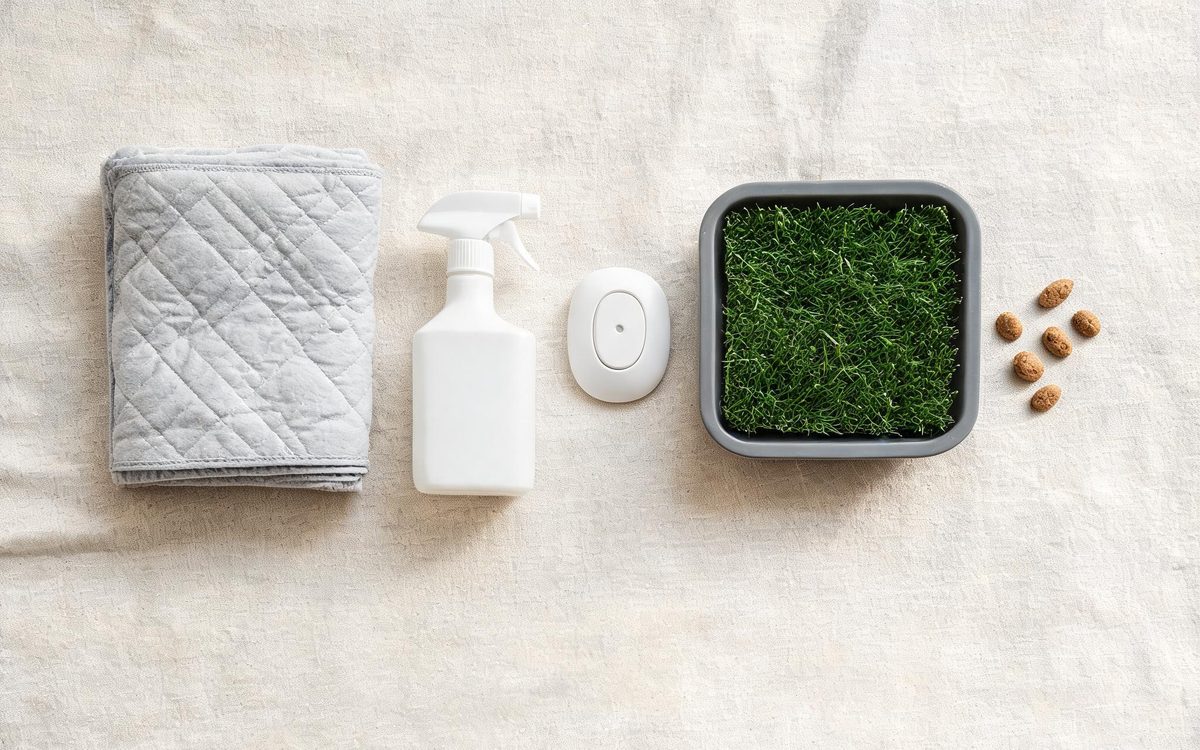
You do not need much for this, and most of what is marketed as potty training gear is a pad with a logo on it. These five are the ones we would replace first if they disappeared from our own cupboard.
Washable pee pads, for the weeks he cannot hold it
The reusable kind beats disposables on two counts: a waterproof backing and a grippy underside mean the pad stays where you put it instead of sliding under a running puppy, and you are not buying a new box every couple of weeks. Machine washable, and a two-pack means one is always dry. See the washable pee pads we use.
An enzymatic cleaner, for the spot he keeps returning to
This is the one product on the list that is genuinely not optional. If you take away nothing else from this article, take this: the reason he goes back to the same corner is smell, not spite.
An enzymatic formula breaks down the urine residue rather than masking it. The one we keep is safe on carpet, hard floor, furniture and fabric, and its flip-and-go sprayer reaches under things without you crawling in after it. See the enzymatic urine cleaner.
A door bell, so he can ask instead of pace
A wireless bell with a touch-activated button sticks to the door frame — no wiring, no drilling if you use the adhesive mount — and the receiver chime plugs in so you can hear it from another room. It turns a vague “he seems restless” into a clear signal, which is exactly what week two of the plan is trying to build. See the wireless dog door bell.
A grass tray, for apartments and bad weather
If you live above the third floor, or your Bichon has decided that January is for indoor dogs, a tray system gives him a real bathroom option that still reads as “outside” to him. Liquid drains through the artificial turf onto an absorbent pad in the tray below, and this one arrives with two spare turf pieces so you can swap a clean one in while the other dries. See the indoor grass potty tray.
Soft training treats, because timing is everything
The reward has to arrive within about two seconds of the behavior, so it needs to be small, soft and instantly edible. Soft puppy treats in the region of six calories each, in a two-bag pack, are the right shape for this job — you are going to hand out a lot of them, and a treat that takes half a minute to chew is a treat that teaches nothing. See the soft puppy training treats.
If you only buy two things: the enzymatic cleaner and the treats. Everything else on this list makes the job easier, but those two are the difference between a habit forming and a habit being undone.
The Five-Month Regression (and Why It Is Normal)
Somewhere around five or six months, a Bichon who has been reliable for weeks starts having accidents again. Owners panic, assume the training failed, and start over from scratch — which is the one response that makes it worse.
Three things are usually happening at once. He is teething and possibly drinking more. He has more freedom than he did a month ago, so he has more opportunities. And he has hit the age where a puppy’s confidence outruns his manners. It is a developmental phase, not a character flaw.
Go back to the week-three version of the plan for two weeks: one room, the same schedule, no scolding. Most regressions resolve in two to three weeks. If it does not, or if the accidents are small and frequent rather than full, read the next section before you read another training book.
Nights: Getting Past the 3 a.m. Wake-Up
Night waking is where most owners quietly give up and start leaving pads down permanently. Two adjustments do most of the work.
First, control the last two hours of the evening. Dinner earlier, water available but not a big drink right before bed, and a final trip out the door just before you turn in. A puppy who has been free-feeding all evening has no predictable nighttime pattern, so this is a schedule problem before it is a bladder problem.
Second, make the night trip boring. Out, pee, straight back in, no play, no chat, dim lights. A 3 a.m. trip that turns into a party is a 3 a.m. trip that gets requested again tomorrow. Most Bichons start sleeping through somewhere between three and five months, and it usually arrives suddenly rather than gradually.
When It Is Not a Training Problem at All
This is the section most potty training articles leave out, and it matters, because a urinary tract infection looks exactly like a training failure. A puppy who was doing fine and then starts going in small amounts, frequently, or licking at himself more than usual is not being difficult — he may be uncomfortable.
Call your vet if you see any of these:
- Frequent tiny pees, or squatting with very little coming out
- Blood in the urine, or urine that looks cloudy or smells unusually strong
- Straining, whining, or licking at the genitals after going
- Accidents that started suddenly in a dog who had been reliable, especially with increased drinking
- Any of the above alongside lethargy, vomiting, or going off food
Urinary infections, crystals, and in older males prostate trouble all present this way, and none of them are fixed by a better schedule. A urine sample is a quick, routine test at the vet, and it is worth asking for early rather than after another month of schedule-keeping.
One more thing worth ruling out in a white, fluffy breed: a Bichon who is scooting, licking, or leaking a little may have an anal gland or skin-fold issue rather than a house-training one. If the accidents come with any of that, get it checked before you rebuild the schedule for the third time.
Frequently Asked Questions
How long does it take to potty train a Bichon Frise?
Plan on four to six months for reliable house training, with the hardest part over in the first six to eight weeks. That splits into three milestones: no accidents while you are supervising (usually two to four weeks on a real schedule), asking to go out (four to eight weeks), and being trustworthy with the run of the house (four to six months). The last one depends more on bladder maturity than on how well you train, which is why a Bichon who is doing everything right at four months can still surprise you at six.
Why are Bichon Frise so hard to potty train?
Three breed-specific reasons and one human one. Their small bladder gives them very little holding time as puppies — roughly one hour per month of age. They were bred as companion dogs, so being sent outside alone feels like a punishment, and many will hold it until they are back with you. Their curly white coat soaks through and mats in wet weather, so a cold rainy yard quickly becomes something they would rather skip. And on the human side, most of us start with a schedule built for a bigger dog, then read the accidents as stubbornness instead of a timing problem.
Are Bichon Frises easy to potty train?
They are willing and they are smart, so the training itself is not the obstacle — the timeline is. A Bichon learns what you teach quite quickly; the difficulty is that a small breed physically cannot hold it as long as the puppy books imply, and that pad training teaches “indoors is fine” at exactly the moment you are trying to teach the opposite. Owners who follow a real schedule and transition off pads deliberately usually find them straightforward. Owners who wait for the dog to ask first usually find them maddening.
Should I use pee pads or take my Bichon outside every time?
Outside is the goal, but pads are a legitimate tool while your puppy physically cannot hold it — especially in an apartment or a high-rise. The mistake is leaving the pad in the same indoor corner forever. Use it inside a pen or beside the crate, then move it a foot closer to the door each day, then onto the doorstep, then outside. That way the pad is a stepping stone rather than a destination you have to un-teach later.
Can a Bichon Frise be left alone for 8 hours?
An adult Bichon can usually manage six to eight hours, but a puppy cannot — and the gap is much bigger than most people expect. At three months, three to four hours is realistic; at six months, up to about six. If your workday is longer than that, the answer is a mid-day visit, a dog walker, or a grass tray, not a longer stretch of holding it. Regularly asking a young Bichon to hold it well past his limit is how you create both accidents and a dog who gets anxious about being left.
What do I do when my Bichon has an accident in front of me?
Interrupt, do not punish. A sharp clap or a neutral “ah-ah” is enough to stop him mid-flow, then pick him up and take him straight outside to the same spot. If he finishes there, reward him like he just solved something — because from his point of view, he did. Never scold after the fact: he cannot link a correction to something he did twenty minutes ago, and what he will actually learn is that going in front of you is dangerous, which is how you end up with a dog who hides behind the sofa to pee.
Wrapping Up
Bichon Frise potty training is slower than the books promise for reasons that have nothing to do with your dog’s intelligence. He has a small bladder, a strong preference for your company, and a coat that makes a rainy yard a genuinely bad deal. None of that is disobedience, and all of it is workable.
Success looks like this: a schedule he can predict, a signal he can give you, and a cleaner that removes the smell so the same corner stops being an option. Everything else is patience with a calendar attached.
Start with the schedule and the enzymatic cleaner — those two solve the majority of cases on their own. Add a door bell once you are ready for him to start asking, and reach for a grass tray if the weather or your stairwell is working against you. And if the accidents are sudden, frequent and small rather than occasional and full, call your vet before you change anything about the training.
If you are still assembling the rest of his first year, our Bichon puppy essentials checklist covers what is actually worth buying, and the right crate for a Bichon Frise is the piece of gear that makes weeks one and two survivable.
Related Reading
- Best Crate for Bichon Frise — the sizes and shapes that actually fit a Bichon, and why a soft crate is usually the wrong call.
- Bichon Puppy Essentials — the first-month shopping list, sorted into what matters and what can wait.
- How Much to Feed a Bichon Frise — get the portions right and the potty schedule gets easier to predict.
- Bichon Frise Itchy Skin — when the licking and the restlessness are a skin problem, not a training one.
Written by Penny Hartley, certified dog trainer (CCDT) and Bichon Frise owner of 9 years. Penny spent a month taking Biscuit out every three hours before a trainer pointed out that she was tracking the clock instead of the dog. Last updated: October 2026.
This article was reviewed for accuracy by Dr. Laura Mendez, DVM. It is for educational purposes only and is not a substitute for professional veterinary advice. Always consult your veterinarian about your dog’s health and any change in urination, thirst or behavior.
As an Amazon Associate, Love Bichon earns from qualifying purchases.