Best Bichon Frise Ear Cleaner: What Groomers Reach For (and What to Skip)
The first sign for us was not a head shake or a paw battering a skull. It was the smell. Mochi came off the grooming table one Friday, dropped onto my lap, and when I did the usual behind-the-ear scratch I caught a warm, yeasty, half-cheese whiff that had absolutely not been there on Monday.
Two things make that smell maddening. A Bichon ear can go from clean to funky in four days, and the shelf of Bichon Frise ear cleaner options hands you forty bottles with no clue which one is a gentle cleanser, which one is medicine nobody prescribed, and which one is mostly perfume.
So here is the whole subject in one place: why this breed’s ears misbehave, the five label tests that separate a useful bottle from an irritating one, the four-minute routine that outperforms every product on this page, the picks for each job, and the smells that mean you should stop shopping and phone the vet.
If you are going to buy exactly one thing, buy a sting-free, alcohol-free ear flush with a neutral pH, because that bottle supports everything else in this article. Everything below it is either a job-specific extra or a groomer’s tool — and keep reading past the shopping, because the bottle is maybe a third of the job.
In this guide:
- Why Bichon Frise ears go sour so fast
- Five label tests for a Bichon Frise ear cleaner
- The five picks, and what each one is actually for
- The four-minute cleaning routine
- How often is often enough (and how often is too much)
- Six things to stop doing to your dog’s ears
- The smells and signs that mean vet, not cleanser
- What changed Mochi’s four-day cycle
- FAQ
Why Bichon Frise Ears Go Sour So Fast
The Bichon Frise Club of America puts the mechanism about as plainly as it can be put: the goal of ear care is to keep the canals clean and dry, which is hard for Bichons because the ears fall over the canal openings, moisture and debris pile up underneath, and hair grows inside the canal. Yeast, bacteria and mites, the club goes on, thrive in anything moist, alkaline, dirty and hairy. A Bichon ear ticks all four boxes.
The anatomy is stacked against you
Start with the plumbing. Banfield’s veterinary team points out that a dog’s ear canal is L-shaped — it runs in horizontally before dropping down to the eardrum — and VCA’s client guide on ear cleaning makes the consequence explicit: material that gets deep into that horizontal canal is genuinely difficult for a dog to expel on his own. Cleaning is what the missing stairwell does for you.
Then add the flap. A prick-eared terrier ventilates; a Bichon covers the drain. Every bath, every rinse, every humid July afternoon leaves water and warmth in a dark covered tube, and the hair in the canal holds the moisture against the skin instead of letting it evaporate.
What the smell actually is
A healthy ear, per the breed club’s standard, is light pink, has only a small amount of wax, and has no smell at all. So “a bit of a smell” is not a normal baseline you have to live with; it is usually the first measurable change.
When the smell turns musty, sweet, or like corn chips and cheese, that is classically yeast — Malassezia, which Banfield’s ear-infection guide describes as a microbe that naturally lives on a dog’s skin and ears and only turns into a problem when the environment changes: damp, occluded, inflamed, or allergic. That is also why the smell comes and goes with the season, the bath schedule, and the pollen count instead of arriving on one clean Tuesday and never returning.
The ear and the skin are the same argument
This is the part almost every product page skips. Recurring yeast in the ears is usually a symptom, and Banfield is blunt that allergies are the leading cause of recurring yeast ear infections, while the Merck Veterinary Manual’s owner page on otitis externa lists allergies among the primary causes alongside parasites, foreign material, bacteria and yeasts. Merck’s warning to owners is the sentence to remember: unless every cause is treated, the condition keeps coming back.
Which means the Bichon whose ears go funky every three weeks is very often the same dog who licks his paws and scratches his flanks. If that is your dog, the bottle is maintenance, not the fix — our breakdown of why Bichon skin itches in the first place covers the other half of the conversation, and it is the conversation to have with your vet over a calendar, not at midnight.
Five Label Tests for a Bichon Frise Ear Cleaner
Hold any bottle up and run it through these five tests. Four of them are about what is not in the liquid.
1. No alcohol, no hydrogen peroxide
VCA’s guidance for owners is direct: cleaners containing hydrogen peroxide or alcohol can irritate the ear canal, and irritate it worse when the canal is already inflamed or ulcerated. Banfield lists peroxide, rubbing alcohol and undiluted vinegar in the same “do not do this” drawer as human antifungal creams, because anything put into an ear with a possibly damaged eardrum can reach deeper structures and affect hearing.
2. Built for routine use, not for rescue
There are cleansers and there are treatments, and the OTC bottle in front of you is a cleanser. Virbac’s Epi-Otic Advanced copy is a good example of honest positioning: routine cleansing of sensitive ears, and a note that it won’t interfere with other ear treatments. That last bit matters enormously if your vet ever prescribes drops, because VCA warns that some cleansers can weaken or deactivate a medication and that you should ask how long to wait between cleaning and medicating.
3. Sting-free pH, and don’t over-read the pH debate
Here the sources genuinely disagree. The breed club recommends an acidic herbal solution for weekly Bichon cleaning, on the logic that yeast loves an alkaline canal; the large veterinary brands formulate neutral-pH, sting-free fluids because those are well tolerated on sensitive and already-scratched skin. Both camps are chasing the same target — a canal environment yeast does not enjoy — and neither one wants you improvising. Take the tested formulation over the DIY chemistry project.
4. The right format for the job
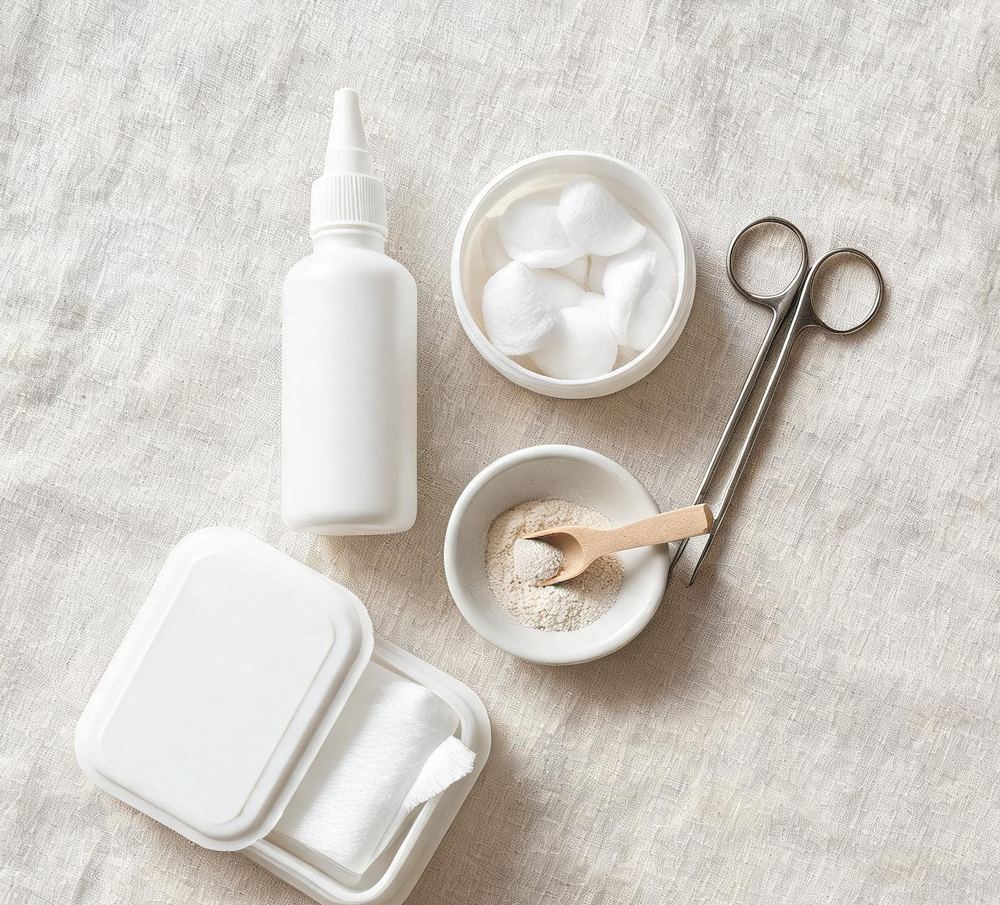
A liquid flush is the only thing that reaches the horizontal canal. Wipes are for what you can see and touch: the flap, the folds, the rim. Powder exists to give forceps a grip on canal hair. A drying solution is for after the bath. Four jobs, four formats — and a wipe that smells great on the flap does nothing about what is brewing down the tube.
5. Unscented beats “fresh” anywhere near a canal
Your Bichon’s entire relationship with this routine is built on whether the first ten seconds hurt or sting. Fragrance is for your bathroom, not his ear. When we compared our picks, the ones we kept reaching for were the ones that admitted on the label what they contain and said nothing about aromatherapy.
The Five Picks, and What Each One Is Actually For
| Product | Best for | Why it earns shelf space | Honest limit | Amazon |
|---|---|---|---|---|
| Epi-Otic Advanced cleanser | Weekly cleaning, both ears, no drama | Neutral pH, sting-free, developed with veterinary dermatologists, aimed at floppy-eared breeds prone to moisture buildup, labeled for use two to three times a week | A cleanser only; the anti-odor claim is about removing the source, not fixing an infection | View on Amazon |
| Zymox Ear Cleanser | The waxy, sour, “needs a proper clean” ear | LP3 enzyme system, no harsh detergents, sold for cleaning non-infected ears and for flushing after an infection has been treated | Same class limit; the brand’s stronger medicated otic versions are a different conversation with your vet | View on Amazon |
| Zymox Advanced Enzymatic Ear Wipes | Daily wipe-down of the flap and folds; travel kit | Unscented, dye-free, no-sting, aloe for temporary redness, enzyme wipe that lifts visible wax | Reaches only what you can touch; never a substitute for a flush | View on Amazon |
| Bio-Groom Ear-Fresh powder | Grip, for canal hair work | Tight-grip powder with a funnel tip so forceps can take hairs one at a time; doubles as a drying and odor powder | A dust cloud and a learned skill; skip it entirely on a red or sore ear | View on Amazon |
| Blunt-tip locking hemostat | Holding canal hair for a groomer-style pull | Curved, fully serrated jaws, ratchet lock and blunt tips, at the small 5.5-inch size a Bichon ear actually needs | Not a starter tool. One wrong grab does real damage; learn the move from a groomer first | View on Amazon |
Every week, both ears: Virbac Epi-Otic Advanced
This is the bottle we keep in the grooming caddy, and it is the one I would hand a new Bichon owner with no further questions. Its copy is written for exactly our problem: routine cleansing of sensitive ears, developed with veterinary dermatologists, recommended for dogs with allergies and for “breeds with floppy ears that are prone to moisture buildup,” sting-free at a neutral pH, and rated for use two to three times a week. It removes debris and excess wax, and its anti-odor claim is the honest kind — removing the material that smells rather than perfuming over it.
What it is not: a treatment. If your dog’s ear is red, painful, discharge-y or has been shaking for two days, no cleanser — this or any other — is the answer, and poking at it makes a bad ear worse.
Epi-Otic Advanced ear cleanser on Amazon
When the ear is properly grubby: Zymox Ear Cleanser
Sometimes the ear is not infected, just overwhelming: thick, brown, waxy, and loud enough that a quick rinse does not move it. The Zymox ear cleanser is the one I reach for then. It is built on Pet King Brands’ LP3 enzyme system, contains no harsh detergents by the label’s own account, is sold for cleaning non-infected ears at any age, and — the phrase I like, because it tells you where the product sits in a treatment timeline — is described as safe for flushing the ears after an infection.
That last point is why it earns a second slot in a Bichon house: after a course of prescription drops, the canal still needs to be kept clean, and a cleanser positioned for exactly that job is a more useful second bottle than a duplicate of the first. The brand also makes stronger medicated otic versions; those are a veterinary decision, not a shelf decision.
The flap, the folds, and the days between: Zymox Advanced Enzymatic Ear Wipes
Wipes get a bad reputation because people use them for a job they cannot do. Used correctly — on the visible inner flap, the rim, and the fold where the ear meets the head — they are the highest-frequency thing in the routine, and they are what keeps four days from becoming two weeks. These are unscented and dye-free with aloe for temporary redness, which is the combination I want for a dog whose ears get rubbed raw by his own hind leg at 3 a.m.
They are also the honest test of your cleaning habit: if the wipe comes away brown and waxy every couple of days, your flush is not doing enough or your dog’s underlying issue is talking. And if you already have another brand of wipes in the bathroom, keep it; the wipes are the least critical item in this article.
Unscented enzymatic ear wipes on Amazon
Two tools for canal hair, if hair is your problem
Not every Bichon has a hairy canal, and plenty of owners are right to skip these two. But if your dog’s canals are full of hair — the breed club says the hair in a Bichon’s canal needs to come out, monthly for their dogs — then the question is not whether to use powder and forceps but whether to use them carefully.
The Bio-Groom Ear-Fresh powder exists to solve the one thing that makes hair-plucking painful: nothing grips a smooth hair. You dust a little into the canal with the funnel tip, the powder gives the forceps something to hold, and hairs can come out one or two at a time. It doubles as a drying and odor-reducing powder, and it has been in groomers’ jars since long before anyone put a QR code on it.
Pair it with a small blunt-tip locking hemostat — 5.5 inches, curved, fully serrated jaws, ratchet lock. Serrations and a lock so you can grip a hair without clamping a fold of skin, and blunt tips because the alternative is a story you tell your vet.
Now the warning, and it comes from the breed club rather than from me: the BFCA’s ear-care article specifically condemns the technique of grabbing the whole mass of hair, twisting and yanking, says it causes major irritation that can lead to inflammation and infection, and tells owners to find a different groomer if theirs will not stop.
What they recommend instead is a few hairs at a time, never gripping skin, and the option of letting a professional do it entirely. Their author also concedes that even correct plucking can leave a Bichon’s ears temporarily inflamed — which is why I would not do this the week after a bath, on a pink ear, or at all until someone who knows has shown you once.
Our pick: the Epi-Otic cleanser and a tub of unscented wipes cover ninety percent of Bichon households. Buy the powder and hemostat only because hair is your specific problem, and buy them before the next grooming appointment so you can watch your groomer use them.
The Four-Minute Cleaning Routine
This is the VCA client-guide procedure, trimmed to what fits a fourteen-pound dog on your lap, with Merck’s cleaning notes folded in. Read it once before you start, because the order is the point.
- Set him up. For a small dog, VCA says the position is on your lap, with your body as the wall. Have treats out before you pick up the bottle; a Bichon who reads your body language should never hear the cap.
- Check before you clean. Look and sniff. If the ear is red, hot, swollen, painful, or leaking, stop and call the vet instead — VCA’s advice is to consult before cleaning an inflamed or painful ear, because it may already be infected or the eardrum may not be intact.
- Lift, don’t pull back. Grasp the tip of the flap and pull it straight up and away from the head. That straightens the L-shaped canal and gives the liquid somewhere to go.
- Flood it. Squeeze in enough cleaner to fill the canal; some spilling out is fine and expected. Do not put the bottle tip into the ear — VCA says to wipe the tip with a clean alcohol-soaked cotton ball if it ever touches, to avoid spreading debris between ears.
- Massage the base for 30 seconds. Pinch the base of the ear below the canal opening and work it until you hear a squish. Merck’s version of the instruction is exactly that: massage until you hear the solution squelch. This is the step everyone skips and the step that does the work.
- Let him shake. Do not restrain it. Shaking is the dog’s own centrifuge, and it moves liquid and debris out of the horizontal canal to the opening.
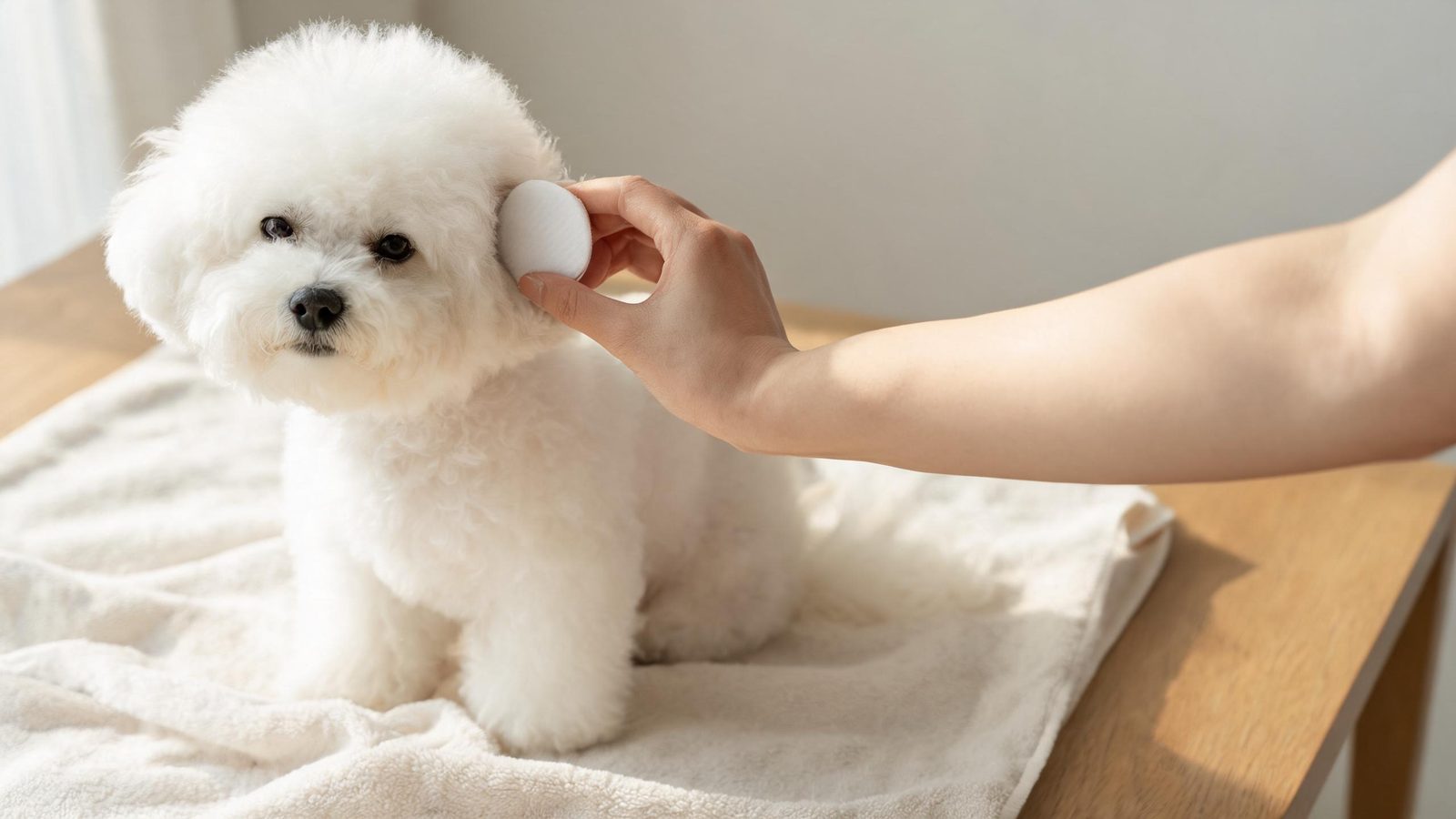
- Wipe only what you can reach. Cotton ball or gauze on the flap and the visible opening. Both VCA and Merck say the same thing in different words: only go into the canal as far as your finger reaches, and never use a cotton swab. Merck adds a small, sensible detail — real cotton balls rather than polyester puffs.
- Dry, then reward. A dry canal is the entire preventive strategy, so finish with a dry folded pad at the opening and a towel over the ear for the last shakes. Then treat, praise, and do the other ear. If he shows pain at any point, stop and call the vet.
Two timing notes. Merck says to wait a few minutes before applying any prescribed medication after cleaning; VCA says to ask your vet whether a delay is even wanted, because some cleansers weaken medication. Ask which way your specific product and prescription go. And do the routine after brushing rather than before, so you are not pushing loose hair down the neck into freshly cleaned ears — our brushing routine and this take four minutes each and combine into one habit.
The 60-second check that rides on top of brushing
The breed club recommends inspecting the canals frequently, ideally every time you brush, which for most Bichon owners means two or three times a week without any extra time on the calendar. You are looking for the healthy picture: light pink, small amounts of wax, no odor. You are watching for the four changes that matter — scratching, head shaking, redness, and any yellow, brown or black discharge. The whole point of the check is that it costs a sniff, and it catches the ear while it is still a cleanser problem.
How Often Is Often Enough (and How Often Is Too Much)
The honest answer is “less than the internet says, more than you think about after baths.” Three sources, one usable schedule:
- The breed club’s baseline: weekly cleaning with a liquid solution for a Bichon, with the brand chosen with your vet.
- The product baseline: cleansers like our top pick are labeled for two to three times a week, which is the ceiling for a dog in an active yeast season, not a target for a healthy ear.
- The caution: VCA is clear that not every dog needs cleaning and that over-cleaning can itself irritate the canal and lead to infection. A healthy ear with no discharge and no odor does not need a weekly flush.
So: check every time you brush, clean about weekly if the ear is damp, waxy or has a faint smell, and go up or down from there with your vet’s blessing. Then hold one line absolutely — dry ears after every bath, because that is free and it is the lever that moves the most. Water and soap in the canal is exactly what the breed club warns groomers and owners to avoid, and our bathing frequency guide covers the shower-cap trick and the cotton-ball-at-the-opening habit that make it work.
Six Things to Stop Doing to Your Dog’s Ears
1. Cotton swabs in the canal
VCA lists two reasons and both are serious: a swab can puncture the eardrum or trauma the canal, and it pushes debris deeper instead of removing it. Merck’s cleaning table puts it in four words: “Don’t use cotton swabs.” The only swab-shaped thing allowed near a dog ear is a cotton ball you can see the whole of.
2. Hydrogen peroxide, rubbing alcohol, undiluted vinegar
These three turn up in every “home remedy” thread and every one of them gets a warning from someone. VCA: peroxide and alcohol irritate the canal, worse if it is already inflamed. Banfield: skip peroxide, alcohol, undiluted vinegar and human antifungal creams, because irritated tissue hurts more and a ruptured eardrum means what you pour in can reach structures that affect hearing.
3. Cleaning more aggressively to “keep up with it”
If the ear needs scrubbing every three days, more cleaning is the wrong variable to turn. That is the over-cleaning trap, and it is also the point where the recurring-yeast and allergy explanation becomes more useful than the shopping cart.
4. The one-yank hair pull
Grab everything, twist, yank. The Bichon Frise Club of America names this technique in groomers, calls the irritation it causes a possible route to inflammation and infection, and tells owners to change groomers over it. A few hairs at a time, powder for grip, never skin in the jaws.
5. Believing a diet cures ear yeast
Banfield takes this myth head-on: a grain-free diet is not a proven treatment or cure for a yeast ear infection, and switching food because of an ear is a decision to make with your vet, since food allergy is a real driver that gets investigated with an actual elimination diet rather than a bag with a trendier label.
6. Treating first and diagnosing never
Every source in this article converges here. Smell cannot tell you whether you are dealing with yeast, bacteria or mites — Banfield notes the two can coexist, and both yeast and mites can produce dark discharge. Merck describes otoscopy and a microscope smear of the discharge as the way this gets sorted, sometimes under sedation when the ear is painful. A cleanser maintains an ear your vet has already cleared.
The Smells and Signs That Mean Vet, Not Cleanser
Owners ask me to smell things, which is fair given the subject. Here is the translation table I actually use, with the caveat that none of it is a diagnosis:
- Musty, sweet, corn chips, cheese: the classic yeast signature. If it comes with redness, wax and itch, it needs a cytology, not a scrub.
- Foul, sour, “wrong”: Banfield’s description of bacterial discharge. Merck lists foul odor among the standard signs of otitis externa.
- Dark, dry, coffee-ground debris: Banfield’s mite picture, especially in a recently adopted or multi-pet dog.
- Blood, or a pink puddle on the pillow: self-trauma or a burst vessel; the shaking itself can puff an ear flap up like a balloon, and that is a vet visit.
And forget the smells for a second if any of these show up, because they are the line I do not negotiate with: pain when you touch the ear, a head held tilted to one side, wobbliness or circling, a swollen or deformed flap, discharge that keeps coming back after two rounds of cleaning, or one stubborn ear that never joined the party. Merck notes that middle-ear spread and one-sided or chronic inflammation are what trigger deeper work — culture, imaging, allergy testing, biopsies in the difficult cases. A head tilt on a small dog who has been shaking for a week is not a “wait and wipe” situation.
One more honest note before the FAQ: the cleansers in this article are drug-free, and Banfield’s team says so in plain words — they may help keep an ear clean, but they cannot deliver the prescription treatment an active infection needs. Using one instead of a diagnosis is how a simple ear issue turns into a surgery conversation, and Merck’s owner page describes chronic cases ending in permanent changes to the canal that only surgery fixes.
What Changed Mochi’s Four-Day Cycle
Our Bichon is not a medically dramatic dog, which is why his ear story is worth telling. The Friday smell, the bottle-buying spiral, and then four unglamorous changes that did what no single product did.
Drying beat cleaning. The biggest single change had nothing to do with which cleanser we bought. Towel the underside of the flap after every bath, a folded dry pad at the canal opening for the last shakes, and no shampoo allowed to run toward the ears. Two weeks after we started, the four-day smell was gone for the first time in a year.
We cleaned less. In our first year we flushed both ears twice a week, all year, and one appointment ended with the vet saying the canals looked irritated rather than infected. We dropped to a weekly check with cleaning only when the ear actually looked or smelled like it needed it, and the redness quietly stopped.
The powder-and-forceps lesson came from a groomer, not a blog. Our groomer showed us the powder, the few-hairs-at-a-time grab, and the rule about never taking hair from a pink ear. We botched the first attempt by grabbing too much, learned more from that afternoon than from any product page, and the hemostat has mostly sat in the caddy ever since because his canal hair is light.
And one ear beat us. A summer ear that smelled exactly like every previous “just wax” episode did not respond to two cleanings, and the smear showed mixed yeast and bacteria. Drops, a recheck, and then — and this is the part nobody tells you — the cleanser came back into use after the course finished. That is the honest relationship between everything on this page and everything at the clinic: one maintains, the other treats, and the moment you swap them is the moment an ear gets worse.
If your Bichon’s ears are on that recurring track, add the ear question to the allergy conversation and keep a note of dates: which month, which shampoo, which season. Our skin-and-coat supplement breakdown is the nearest thing on this site to a supporting-role purchase, and the honest sentence in it applies here too: supplements support a plan, they do not replace a diagnosis.
Frequently Asked Questions
What ear cleaner do vets recommend for a Bichon Frise?
Ask the question as a category, not a brand: you want a drug-free cleanser made for routine use in a sensitive ear — alcohol-free, peroxide-free, sting-free — and VCA notes that some formulas also carry antibacterial or antifungal additives and that some are better at wax, which is exactly the choice your vet can make for your dog’s specific ear. Our default is a neutral-pH, sting-free flush labeled for floppy-eared breeds prone to moisture buildup, used two to three times a week at most.
How often should you clean a Bichon Frise’s ears?
Inspect every time you brush, which is where the breed club lands, and clean about weekly if the ear is damp, waxy or faintly smelly — the Bichon Frise Club of America’s own guidance is weekly for the breed. Then subtract: VCA warns that over-cleaning irritates the canal and can itself invite infection, so a clean, odor-free ear does not need flushing. Whatever the number, dry the ears after every bath.
Why do my Bichon Frise’s ears smell like cheese or corn chips?
That musty, sweet, snack-like smell is the classic signature of Malassezia yeast, which Banfield describes as a normal resident of dog skin and ears that overgrows when the environment changes — trapped moisture after a swim or bath, a floppy flap, a hairy canal, or underlying allergy. Smell plus redness, wax and itching means get a cytology, because the odor tells you yeast is likely but not what else is living there.
Can I use hydrogen peroxide or apple cider vinegar in my dog’s ear?
No. VCA warns that cleaners with hydrogen peroxide or alcohol can irritate the ear canal, especially an inflamed or ulcerated one, and Banfield tells owners to skip peroxide, rubbing alcohol and undiluted vinegar altogether, adding that anything entering an ear with a damaged eardrum can reach deeper structures and affect hearing. Merck’s cleaning note goes the same direction: use the solution your vet recommends and skip over-the-counter wax removers unless they approve.
Do Bichon Frise ears need to have the hair plucked?
Some do, and this is the one place groomers, breed clubs and veterinarians genuinely weigh risk differently. The Bichon Frise Club of America says canal hair should be plucked monthly, a few hairs at a time with powder for grip and never with skin in the forceps, and warns that the twist-and-yank technique causes irritation that can lead to infection. Plenty of vets prefer clipping the hair out around the opening and keeping the ear dry instead. If your dog needs hair work, have your groomer show you the technique once, and never do it on a red or sore ear.
How do I get the brown gunk out of my dog’s ear?
Fill the canal with cleanser, pull the flap up, massage the base for 30 seconds until it squishes, let him shake, then wipe only what your finger can reach — that is the VCA and Merck procedure, and it moves brown wax without anything entering the canal. If the gunk returns within days, comes with odor, or the ear is red, that is not wax maintenance any more; it earns a vet visit rather than a second bottle.
Wrapping Up
Strip the Bichon Frise ear cleaner shelf down to what matters and you get one good bottle, one good habit and one clear boundary. The bottle is a sting-free, alcohol-free, neutral-pH flush used only when the ear asks for it. The habit is the 60-second look and sniff every time you brush, plus dry ears after every single bath — that pairing did more for our four-day cycle than any product we have tested. The boundary is this: cleansers maintain a cleared ear, and ears that hurt, tilt, wobble, bleed or keep coming back belong to a veterinarian with a microscope.
Buy the cleanser, keep the wipes for the flap, buy the powder and hemostat only if canal hair is genuinely your problem, and go learn the four-minute routine this evening while his ears still smell like nothing. That is the whole game, and it is a game you can win in a bathroom with a cotton ball.
Related Reading
- How often to bathe a Bichon Frise — the bath side of the same problem, including keeping water and shampoo out of the ears.
- Why your Bichon Frise is itchy — causes and fixes — the allergy conversation behind recurring ear trouble.
- The Bichon Frise grooming kit we actually use — everything else that lives in the caddy next to the ear bottle.
- Best tear stain removers for Bichon Frise — the other damp-fold issue on the same face.
Written by Penny Hartley, certified dog trainer (CCDT) and Bichon Frise owner of 9 years. Penny has held a wiggly white dog through more at-home ear cleanings than she can count and one long-remembered vet lecture about cotton swabs. Last updated: October 2026.
This article was reviewed for accuracy by Dr. Laura Mendez, DVM. It is for educational purposes only and is not a substitute for professional veterinary advice. Always consult your veterinarian about your dog’s health, especially before putting anything into an ear that is red, painful or discharge-y, and never start or stop a medication or supplement based on what you read online.
As an Amazon Associate, Love Bichon earns from qualifying purchases.